
What Is Filing Status? The 5 Types Explained
Filing status looks like the easiest box on the return — pick one of five, move on. On the EA exam it’s one of the most reliable places to lose a point. The traps aren’t in the definitions; they’re in the edges: a married person who can still be Head of Household, a widow whose status flips entirely on whether a child lives at home, a “more than half” test where exactly half fails. This walkthrough is built around those edges.
TRY IT · DOMAIN 1 · FILING STATUS
In 2025, Teresa is legally married but files apart from her spouse. Her spouse moved out on July 10 and did not live in the home for the rest of the year. Teresa’s dependent son lived with her all year, and she paid more than half the cost of keeping up the home. What is Teresa’s correct filing status?
- A. Head of Household
- B. Married Filing Separately
- C. Single
- D. Qualifying Surviving Spouse
Hold your answer. The trap is one specific date. Work through the sections, then check yourself at the reveal in Section 6.
Key Takeaways
- Five statuses: Single, MFJ, MFS, Head of Household, Qualifying Surviving Spouse. Your status is fixed by your situation on December 31 — with a death exception.
- Head of Household needs all three: unmarried or “considered unmarried,” you paid more than half the home’s cost, and a qualifying person. Exactly half is not enough.
- “Considered unmarried” lets a legally married taxpayer file HoH — but only if the spouse did not live in the home during the entire last six months of the year.
- The parent exception: a dependent parent does not have to live with you for HoH. Every other qualifying person generally must.
- Qualifying Surviving Spouse is for the two years after the year of death, and it requires a dependent child. The year of death itself is usually MFJ.
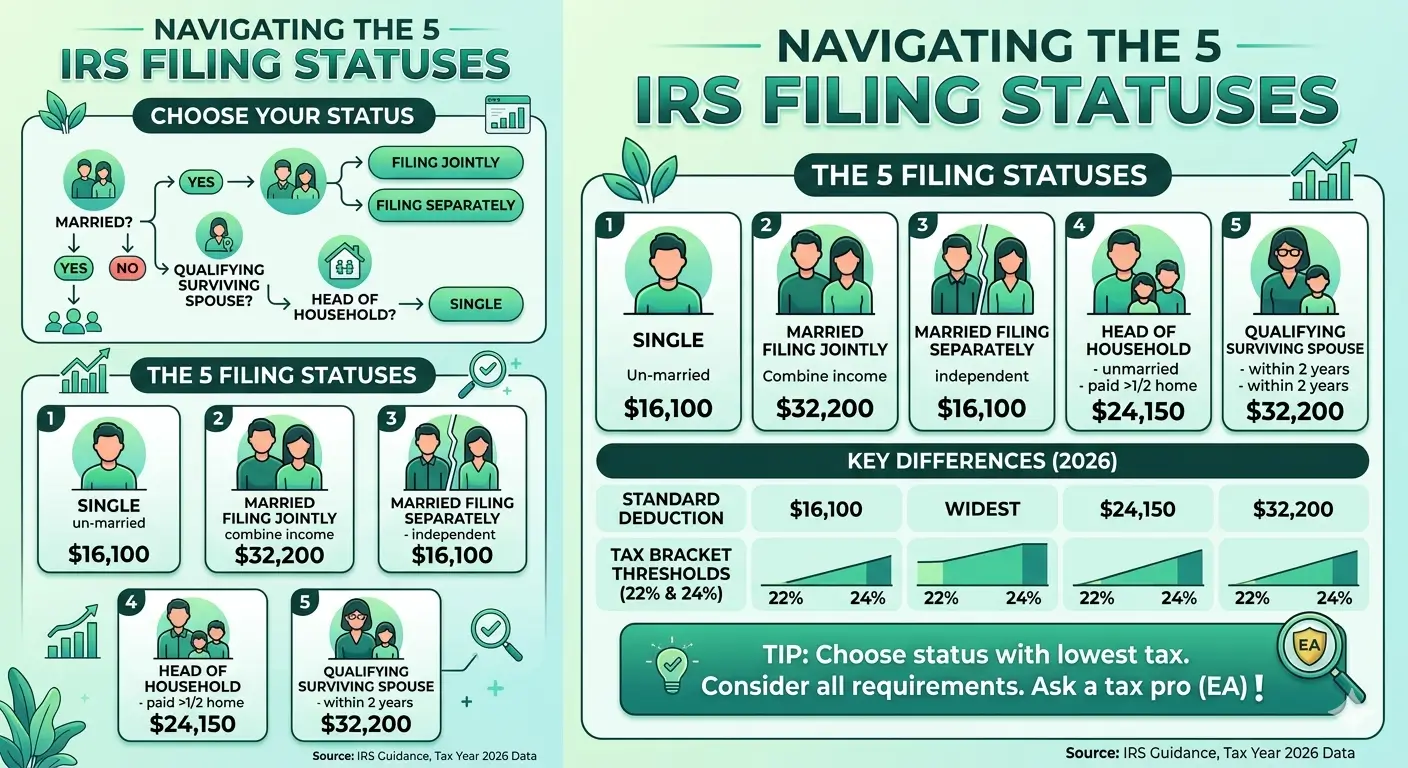
Table of Contents
- 1. Where Test-Takers Lose Points on Filing Status
- 2. The Five Statuses and the Dec 31 Rule (2025 Figures)
- 3. The Head of Household Trap
- 4. Qualifying Surviving Spouse: The Timing Trap
- 5. Why MFS Quietly Costs You
- 6. Back to Teresa — the Answer
- 7. Full Question Set & Domain Review
- 8. EA Insight: Exam ↔ Practice
- 9. People Also Ask
1. Where Test-Takers Lose Points on Filing Status
Almost nobody misses “which status has the biggest standard deduction.” The exam knows that, so it doesn’t ask that. It asks the version with a hook: a married taxpayer who might qualify for Head of Household, a widow whose child moved out, a caregiver whose parent lives in a facility three states away, a couple who split up in the summer.
Each of those turns on a precise rule most candidates half-remember. The date the spouse moved out. Whether the qualifying person is a child or a parent. Which year counts as the year of death. Get the concept but miss the edge, and the distractor answer is sitting right there waiting for you. The whole topic rewards precision over familiarity.
2. The Five Statuses and the Dec 31 Rule (2025 Figures)
Your filing status is set by your situation on the last day of the tax year. Marry on December 30 and you’re treated as married for the whole year; divorce on December 30 and you’re unmarried for the whole year. The one exception: if a spouse dies during the year, the survivor is still generally treated as married for that year.
| Filing Status | Standard Deduction (2025) | Core Requirement |
|---|---|---|
| Single | $15,750 | Unmarried or legally separated on Dec 31 |
| Married Filing Jointly | $31,500 | Married on Dec 31, one combined return |
| Married Filing Separately | $15,750 | Married, choosing to file separate returns |
| Head of Household | $23,625 | Unmarried/considered unmarried + >half home cost + qualifying person |
| Qualifying Surviving Spouse | $31,500 | Widowed within 2 years + dependent child at home |
2025 standard deduction amounts as raised by the OBBBA (IRS IR-2025-103), reflecting tax law through December 31, 2025 — the 2026 testing cycle.
On brackets, hold one structural fact rather than a wall of numbers: MFJ has the widest brackets at every rate, Head of Household sits between Single and MFJ, and MFS uses the same lower-rate widths as Single. A detail the exam likes: the MFS top-rate thresholds are exactly half of the MFJ thresholds — the mechanical reason MFS often costs a couple money rather than saving it.
3. The Head of Household Trap
Head of Household is the single most tested — and most misused — status in Domain 1. It gives a standard deduction thousands of dollars above Single and kinder brackets, so it’s worth a lot, which is exactly why the rules are strict. Three tests, all required:
- Unmarried or “considered unmarried” on December 31.
- You paid more than half the cost of keeping up the home for the year.
- A qualifying person lived with you more than half the year — with one exception below.
Trap 1 — “More than half” means more than half
The cost test is more than 50%. Exactly 50% fails. A question that hands you numbers landing on a clean 50/50 split is testing whether you’ll round up in your head. Don’t.
Trap 2 — A married person can be Head of Household
This is the one candidates fight against, because “married” feels like it locks you into MFJ or MFS. It doesn’t. A legally married taxpayer is “considered unmarried” — and can file HoH — if the spouse did not live in the home at any time during the last six months of the year (July through December), the taxpayer paid more than half the home’s cost, and a qualifying child lived there more than half the year.
The edge the exam writes to is that six-month line. Not “moved out sometime in summer.” Not “gone most of the year.” The spouse must be out of the home for the entire second half. One day in July inside the home, and the test fails.
Trap 3 — The parent exception
A qualifying person normally has to live with you. A dependent parent is the exception: they can live somewhere else — even a care facility in another state — and you can still file HoH, as long as they’re your dependent and you pay more than half the cost of keeping up their main home or facility. Candidates who reflexively apply the “must live with you” rule miss this every time.
One more, quietly: a dependent alone doesn’t make you HoH. The qualifying person must be the right kind — a qualifying child, a dependent parent, or certain dependent relatives. A dependent who is an unrelated member of the household (a partner you support, for example) does not open Head of Household.
4. Qualifying Surviving Spouse: The Timing Trap
Qualifying Surviving Spouse (once called “Qualifying Widow(er)”) gives a grieving taxpayer the MFJ standard deduction and MFJ brackets for a limited window. Two facts carry almost every exam question on it.
First, the timing. The year the spouse dies is usually MFJ, not QSS — the survivor is still treated as married for that year. QSS applies to the two tax years after the year of death. Candidates who label the year of death “QSS” walk straight into the distractor.
Second, the child. QSS requires a dependent child living in the home. Take the child away and the same widow, in the same year, usually files as Single — not QSS, and not HoH. The exam loves to run the identical fact pattern twice, once with a dependent child and once without, and let the answer split entirely on that.
| Year | Status (with dependent child) |
|---|---|
| Year spouse dies | Married Filing Jointly |
| Two years after | Qualifying Surviving Spouse |
| Year 3 and beyond | Head of Household or Single |
Remarriage before December 31 ends QSS for that year immediately.
5. Why MFS Quietly Costs You
Married Filing Separately is rarely a trap of definition — it’s a trap of consequences, and the exam tests the consequences. Choosing MFS shuts off or shrinks a long list of benefits:
- No Earned Income Credit, and generally no education credits or Child and Dependent Care Credit.
- No student loan interest deduction.
- If one spouse itemizes, the other must itemize too — even if their itemized total is near zero.
- Lower IRA-related phase-out thresholds, and Medicare IRMAA surcharges that bite at lower income.
Where MFS genuinely helps is narrow: separating one spouse’s large medical expenses from a high joint AGI, keeping finances apart during a separation, or shielding a refund from the other spouse’s federal debt. The exam-worthy takeaway is that MFS is a deliberate trade, not a default.
6. Back to Teresa — the Answer
Teresa checks a lot of HoH boxes: a dependent child in the home all year, more than half the household cost paid by her, filing apart from her spouse. That’s the pattern the trap is built on. The single fact that decides it is the date the spouse left.
TRY IT — ANSWER
Answer: B — Married Filing Separately
To file HoH as a married person, Teresa would need to be “considered unmarried” — which requires her spouse to have been out of the home for the entire last six months of the year (July 1–December 31). Her spouse moved out July 10, so he lived in the home during part of July. That breaks the test. Since she’s still legally married, filing apart from her spouse, her status is MFS.
- A (Head of Household) is the trap — the child, the cost, the absent spouse all point there, but July 10 fails the six-month rule by ten days.
- C (Single) is wrong; she’s legally married on December 31.
- D (Qualifying Surviving Spouse) is wrong; QSS requires a deceased spouse.
Source: IRC §2(b) (head of household); §7703(b) (considered unmarried — spouse not a member of the household for the last six months, plus a qualifying child).
That was 1 of 5 questions on this concept.
The EA Exam Part 1 Made Simple series carries the full Try It set for filing status — the “considered unmarried” boundary, the parent exception, the QSS-with-and-without-a-child split — plus the answer key with IRC citations and an end-of-domain review that mixes these the way the real exam does. Plain-English, built to teach the edge, not just the label.
See the EA Exam Part 1 series →EA Insight: Where the Exam Meets the Return
Head of Household is the status I correct most often in real work — and the exam version of the trap is the exact one I see at the desk. A couple hits a rough patch, one spouse moves out midway through the year, and the one who stays files HoH claiming the kids. It feels right. But if the spouse was in the home any time after June 30, the “considered unmarried” test is gone, and the return is wrong. The IRS flags these through matching. Same rule, same edge, whether it’s a test question or a client sitting across from me.
The other one is quieter and costs more: a newly widowed person who defaults to Single because no one mentioned Qualifying Surviving Spouse. With a dependent child at home, that’s two years of MFJ-level deduction and brackets — real money left behind out of not knowing the status exists.
So the drill I use is the same for studying and for the intake chair: don’t ask “are they married.” Ask “what happened this year, and on what date?” Marriage, divorce, a spouse moving out, a spouse dying, a child leaving home — the right status hangs on the timeline, and the exam writes its distractors precisely where the timeline is fuzzy.
People Also Ask
Can a married person ever file as Head of Household?
Yes — if “considered unmarried.” The spouse must not have lived in the home at any point during the last six months of the year, the taxpayer must pay more than half the home’s cost, and a qualifying child must live there more than half the year. Miss the six-month window and the taxpayer is back to MFJ or MFS.
Does the qualifying person always have to live with me?
Almost always — with one exception. A dependent parent does not have to live with you. If you pay more than half the cost of keeping up your parent’s home or care facility and they’re your dependent, you can file HoH even though they live elsewhere. This parent exception is a frequent exam item.
My spouse died this year — do I file QSS?
Not for the year of death. That year is usually Married Filing Jointly, because you’re still treated as married for the whole year. Qualifying Surviving Spouse is available for the two tax years after the year of death, and only if you have a dependent child living with you and haven’t remarried.
If one spouse itemizes on MFS, must the other?
Yes. On separate returns, if one spouse itemizes deductions, the other spouse must also itemize — even if their itemized total is small or zero. This is a classic MFS trap and a common exam question.
Is paying exactly half the household cost enough for HoH?
No. The test is more than half. Exactly 50% does not qualify. A question that produces a clean 50/50 split is checking whether you’ll treat “half” as “more than half” — they’re not the same.
Related Articles
Official Resources
Disclaimer: This article is for educational and exam-preparation purposes only and does not constitute tax, legal, or financial advice. Dollar figures reflect the 2025 tax year (2026 EA testing cycle, tax law through December 31, 2025), including the OBBBA standard deduction amounts. Tax law and figures change — always confirm current amounts at IRS.gov, or consult a qualified tax professional for advice specific to your situation. eataxwise.com and its author are not responsible for actions taken based on this article.