
“She earns $60,000, so she’s in the 22% bracket.”
Look at the bracket table, find where $60,000 lands, read off the rate. That’s how most candidates answer this — and it’s how they lose the point.
Brackets never touch your paycheck. They apply to taxable income, which sits several steps down the return. Subtract the standard deduction from that $60,000 and the answer moves an entire bracket. The exam knows exactly where you’ll shortcut, and it builds the wrong answer to catch you there.
TRY IT · WORK IT OUT FIRST
Teresa files as Single. She earned $60,000 in wages, has no other income and no adjustments, and claims the standard deduction rather than itemizing.
What is Teresa’s marginal tax rate?
The answer and its statutory basis come midway through this post. Build the concepts below first.
Key Takeaways
- Seven federal rates apply to individuals: 10, 12, 22, 24, 32, 35, and 37 percent.
- Brackets attach to taxable income — gross income reduced by adjustments and then by the standard or itemized deduction. Never to wages on a W-2.
- Rates are marginal. Each layer of income is taxed at its own rate, so a raise into a higher bracket can’t shrink take-home pay.
- The marginal rate (the rate on the last dollar) always exceeds the effective rate (total tax divided by taxable income).
- Filing status picks which threshold table applies, and it also sets the standard deduction — so it moves the answer twice.
- Long-term capital gains and qualified dividends run on a separate rate schedule (0, 15, 20 percent), not these brackets.
- The seven rates are permanent under current federal tax law. The dollar thresholds still shift each year with inflation.
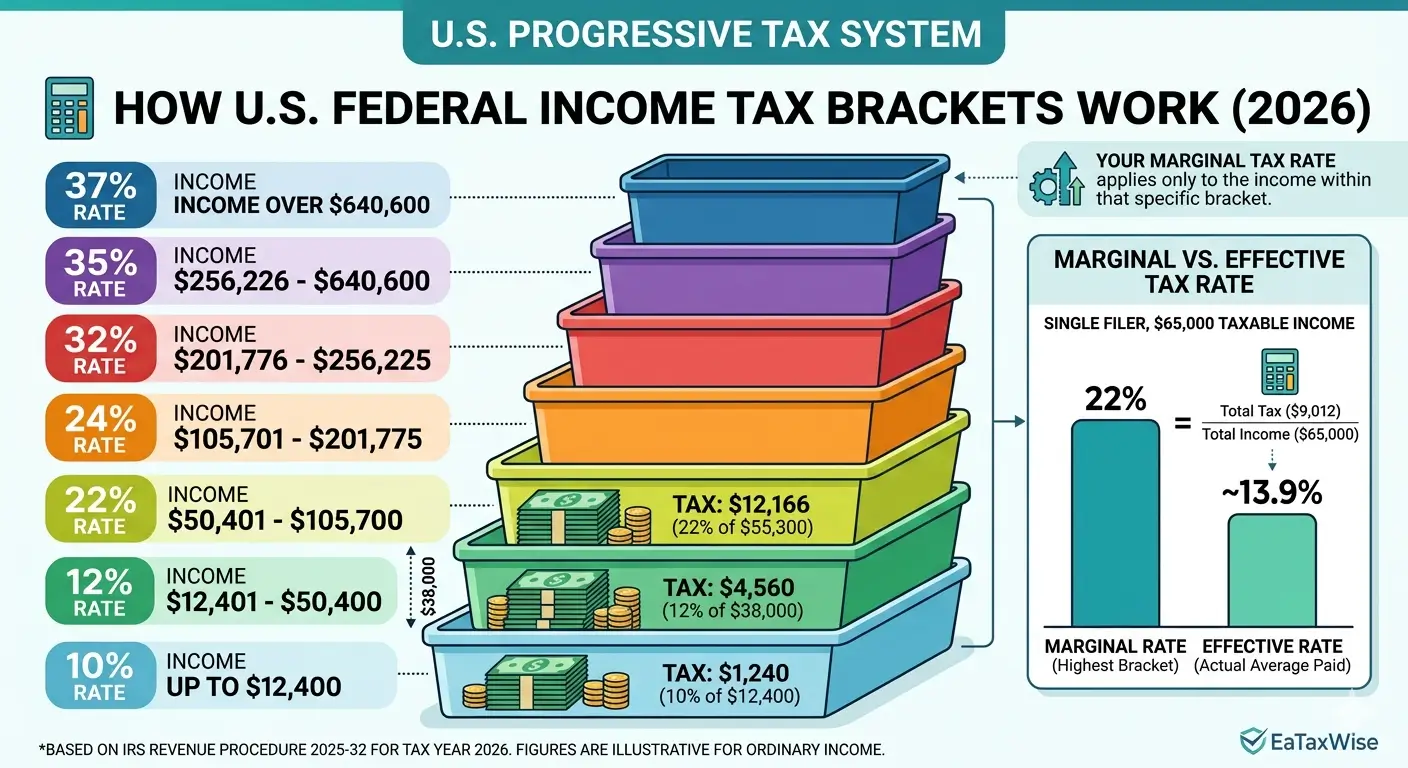
Table of Contents
- 1. The Number Brackets Actually Attach To
- 2. Marginal Means Layers, Not One Rate
- 3. Bracket Thresholds by Filing Status
- 4. Answer Revealed
- 5. Marginal vs. Effective — Which One the Question Wants
- 6. Three More Places the Exam Sets Traps
- 7. Study Note — What Each Wrong Answer Tests
- 8. EA Insight
- 9. Frequently Asked Questions
- 10. Related Articles
- 11. Official Resources
1. The Number Brackets Actually Attach To
A bracket is a range of income assigned one rate. Simple enough. The difficulty is knowing which income the range measures, because the return produces several different income figures and only one of them meets the brackets.
Income moves down the return in three stages. Gross income comes first — everything §61 sweeps in. Subtract the above-the-line adjustments and you land on adjusted gross income. Subtract the standard deduction or itemized deductions from AGI and you finally reach taxable income. That last number, and nothing above it, is what the bracket table reads.
The chain that has to run before any bracket applies
Gross income → less adjustments → AGI → less standard or itemized deduction → Taxable income → brackets
Skip a link in that chain and the rate you report will be too high. A single filer claiming the standard deduction knocks $15,750 off AGI before any rate touches the money. That deduction alone can carry someone out of one bracket and into the one below.
Watch for questions that hand you a salary figure and stop there. The salary is bait. Run the chain.
2. Marginal Means Layers, Not One Rate
Saying “I’m in the 22% bracket” describes one slice of income, not the whole pile. Taxable income gets cut into layers, and each layer pays its own rate.
The first dollars are taxed at 10 percent no matter how much someone earns. The next layer pays 12 percent. Only the topmost layer — the part that reaches into the highest bracket a taxpayer touches — pays the marginal rate.
This structure kills the most persistent myth in American tax conversation: that a raise can leave you worse off. It can’t. A raise that crosses a threshold subjects only the amount above that threshold to the higher rate. Every dollar underneath keeps its old, lower treatment.
3. Bracket Thresholds by Filing Status
Filing status decides which table you read. Note how much wider the joint columns run — that width is why status changes the answer even when income doesn’t move.
| Rate | Single | Married Filing Jointly | Head of Household |
|---|---|---|---|
| 10% | $0 – $11,925 | $0 – $23,850 | $0 – $17,000 |
| 12% | $11,925 – $48,475 | $23,850 – $96,950 | $17,000 – $64,850 |
| 22% | $48,475 – $103,350 | $96,950 – $206,700 | $64,850 – $103,350 |
| 24% | $103,350 – $197,300 | $206,700 – $394,600 | $103,350 – $197,300 |
| 32% | $197,300 – $250,525 | $394,600 – $501,050 | $197,300 – $250,500 |
| 35% | $250,525 – $626,350 | $501,050 – $751,600 | $250,500 – $626,350 |
| 37% | Over $626,350 | Over $751,600 | Over $626,350 |
Married Filing Separately tracks the Single columns through the 32 percent bracket, then splits from them at the top: 35 percent runs from $250,525 to $375,800, and 37 percent starts above $375,800.
Two details in this table earn exam points. Joint thresholds double the single figures through most of the schedule but stop short of doubling at the very top, which is where the so-called marriage penalty survives. And Head of Household beats Single in the low and middle ranges while merging with it at 22 percent and above — a wrinkle that catches candidates who assume HoH is uniformly wider.
Standard deduction by status
Single $15,750 · Married Filing Jointly $31,500 · Head of Household $23,625 · Married Filing Separately $15,750. These come off AGI before the table above ever applies.
Thresholds reflect the tax year tested on the current EA exam cycle (Rev. Proc. 2024-40, with the standard deduction as amended by the One Big Beautiful Bill Act). Amounts are indexed annually.
You now have every figure the Try It question needs. Run Teresa’s numbers before reading on.
4. Answer Revealed
Answer: B — 12%
$60,000 wages − $15,750 standard deduction = $44,250 taxable income
For a single filer the 12 percent bracket runs from $11,925 to $48,475, and $44,250 sits inside it. Teresa’s last dollar is taxed at 12 percent, so 12 percent is her marginal rate. Answer A reads the table against her wages instead of her taxable income — the whole point of the question. C mistakes the bottom layer for the marginal rate. D confuses the two rate concepts; the marginal rate is read straight off the table and needs no effective-rate computation.
Her actual tax runs $1,192.50 on the first $11,925 at 10 percent, plus $3,879 on the remaining $32,325 at 12 percent — $5,071.50 in total. Against $44,250 of taxable income that’s an effective rate near 11.5 percent, and against her $60,000 salary it’s closer to 8.5 percent. Three different percentages describe one taxpayer, which is precisely why the exam insists you name which one it wants.
The governing provisions are §1, which imposes the rate schedules by filing status and indexes the thresholds under §1(f); §63(a)–(b), defining taxable income as gross income less deductions, with the standard deduction under §63(c); and §62, which sets the adjustments that produce AGI.
5. Marginal vs. Effective — Which One the Question Wants
Two rates, two jobs. Mixing them up costs points on questions that would otherwise be free.
| Marginal rate | Effective rate | |
|---|---|---|
| What it is | Rate on the last dollar of taxable income | Total tax ÷ taxable income |
| How you get it | Read it off the bracket table | Compute the tax first, then divide |
| What it answers | What the next dollar costs — bonuses, deferrals, deduction value | What the year cost overall |
Planning questions almost always want the marginal rate, since it prices the next dollar in or out. A deductible retirement contribution saves tax at the marginal rate, not the effective one. Questions about overall burden, or comparisons across years, want the effective rate.
6. Three More Places the Exam Sets Traps
Capital gains don’t use these brackets
Long-term capital gains and qualified dividends run on their own schedule at 0, 15, and 20 percent under §1(h). Assets held a year or less produce short-term gain, which does fall back into the ordinary brackets above. A question that mentions a holding period is usually testing which schedule applies.
Permanent rates, moving thresholds
The seven rates are permanent under current federal tax law. The dollar figures that bound them are not fixed — they’re indexed for inflation using the chained CPI, which is what keeps bracket creep in check. Rates permanent, thresholds indexed: those two facts get swapped in answer choices constantly.
Filing status moves the answer twice
Changing status swaps the threshold table and the standard deduction. A question that changes only the status while holding income constant is testing whether you remembered to change both. Adjust one and your taxable income will be wrong before the table is ever consulted.
Study Note — What Each Wrong Answer Tests
A (22%) — tests whether you apply brackets to taxable income rather than wages. This is the primary trap, and it’s the choice that looks most reasonable at a glance.
C (10%) — tests the meaning of marginal. Ten percent applies to the bottom layer of every return, which makes it feel safe and makes it wrong.
D (need the effective rate first) — tests whether you can separate the two rate concepts. The marginal rate comes straight from the table; no tax computation is required to name it.
EA Insight
A client once turned down about $3,000 of year-end overtime because a coworker warned him it would “bump him into the next bracket and cost him more than he’d make.” He was single with roughly $47,000 of taxable income. The overtime would have pushed a little over $1,600 of it into the 22 percent layer, costing him around $160 more than the 12 percent that layer would otherwise have paid. He gave up $3,000 to avoid $160. That advice circulates in break rooms every December, and it costs real money.
The place I actually watch closely is the opposite one — clients sitting just above a threshold who could still move. A taxable income a few thousand dollars over a bracket line is a live planning situation until the deadline passes for the relevant contribution. Whether a deductible contribution pays off depends on the marginal rate that applies to the specific dollars it removes, so I compute where the line falls before recommending anything. Sometimes it shaves a real amount off the bill. Sometimes it moves nothing and the client is better served putting the cash elsewhere.
For the exam, carry one habit into the room: when a question hands you a salary, write down taxable income before you look at any table. Candidates lose these points from speed, not ignorance. The bracket table is the last step, never the first.
Frequently Asked Questions
Do tax brackets apply to my salary?
No. They apply to taxable income — gross income reduced by adjustments and then by the standard or itemized deduction. Salary is where the calculation starts, not where brackets attach.
Can a raise leave me with less money?
No. Only the income above the new threshold is taxed at the higher rate, and everything below keeps its original rates. Additional income always raises after-tax pay.
What separates the marginal rate from the effective rate?
The marginal rate applies to the last dollar of taxable income and is read from the bracket table. The effective rate is total tax divided by taxable income, and it’s always the lower of the two.
Are long-term capital gains taxed using these brackets?
No. Long-term gains and qualified dividends use a separate schedule of 0, 15, and 20 percent. Short-term gains are taxed as ordinary income under the brackets shown above.
Do the brackets change every year?
The seven rates are permanent under current federal tax law. The income thresholds that define each bracket are indexed annually for inflation, so the ranges shift even though the rates hold.
Does filing status change more than the bracket table?
Yes. Status sets the standard deduction as well, so it changes taxable income before it changes which thresholds apply. Both effects have to be applied together.
One Thing to Do Today
Take a salary figure of your own choosing and run it through the full chain by hand for all three statuses — Single, Married Filing Jointly, Head of Household. Subtract the right standard deduction each time, then find the marginal rate. Watching one income produce three different rates locks in why the table is always the last step.
Official Resources
Disclaimer: This article is prepared for EA exam study and general education. It isn’t tax, legal, or financial advice. Tax law changes and individual facts vary. Verify current figures at IRS.gov and consult a qualified tax professional about your own situation.