
What Is MAGI? Modified Adjusted Gross Income
On the EA exam, MAGI is almost never the answer by itself. It’s a number the question hands you so it can watch what you do with it — and the fastest way to lose a point in Domain 3 or Domain 4 is to treat “MAGI over the threshold” as the tax base, or to memorize one MAGI formula and apply it to a rule it doesn’t fit. This post walks through where test-takers slip, using the traps the exam actually writes.
TRY IT · DOMAIN 4 · NIIT
In 2025, a single taxpayer has modified adjusted gross income (MAGI) of $240,000 and net investment income of $28,000. The NIIT threshold for a single filer is $200,000. What is the taxpayer’s Net Investment Income Tax?
- A. $1,064
- B. $1,520
- C. $9,120
- D. $0
Hold your answer. Work through the sections below, then check yourself at the reveal in Section 6.
Key Takeaways
- MAGI is AGI with specific deductions added back. Which ones get added back depends entirely on the rule being tested — there is no single MAGI.
- The exam rarely stops at “what is MAGI.” It uses MAGI as one input to a phase-out, a threshold, or a “lesser of” comparison. Know the second step.
- The NIIT is 3.8% of the lesser of net investment income or the amount MAGI exceeds the threshold — not 3.8% of MAGI, and not 3.8% of all investment income.
- Roth IRA eligibility, traditional IRA deductibility, and the education credits all phase out over MAGI ranges. The filing status and the specific range are testable facts.
- The IRA contribution limit is a combined traditional + Roth cap. Funding both to the max is a classic MAGI-adjacent trap that triggers the 6% excess tax.
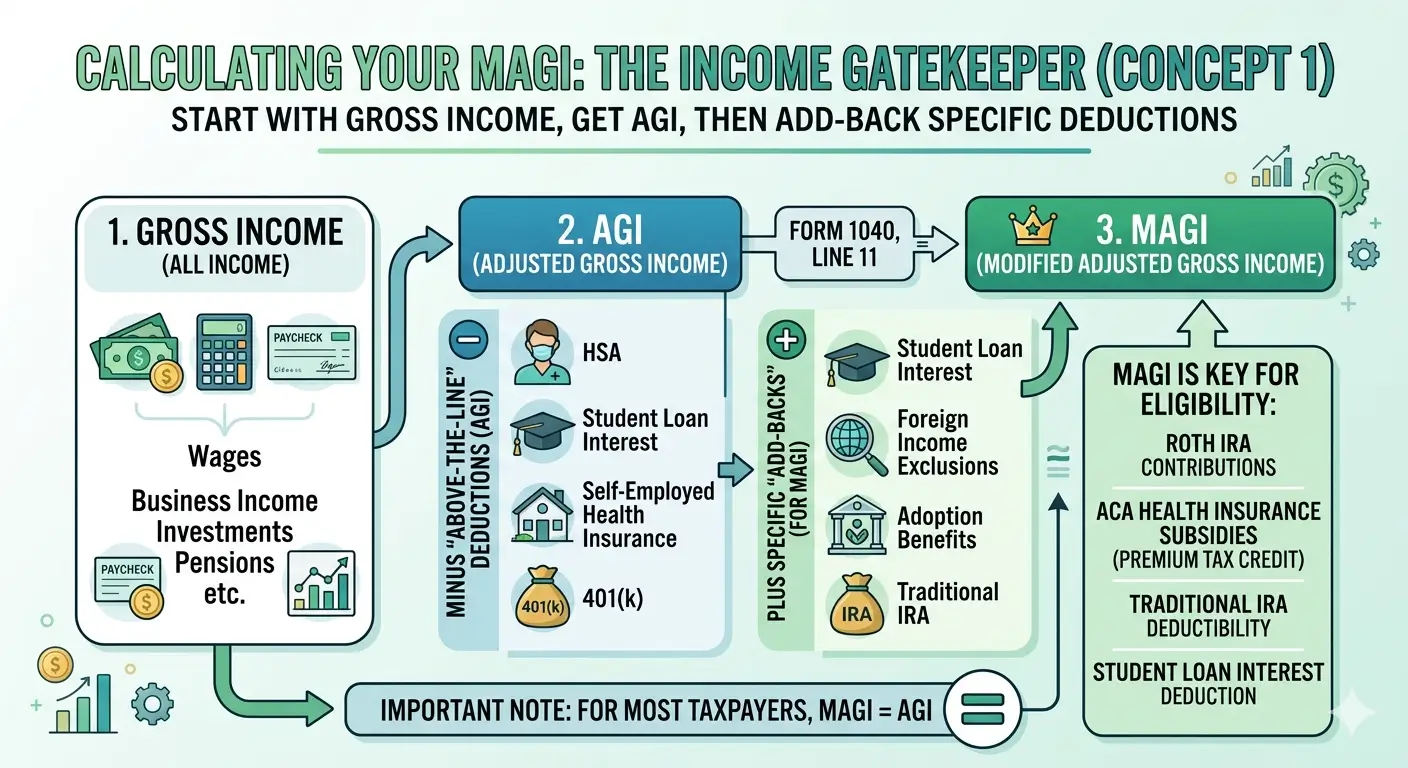
Table of Contents
- 1. Where Test-Takers Lose Points on MAGI
- 2. MAGI in One Line: AGI + Add-Backs
- 3. Why There’s No Single MAGI
- 4. The Phase-Outs the Exam Loves (2025 Figures)
- 5. The IRA Combined-Limit Trap
- 6. The NIIT “Lesser Of” Trap — and the Answer
- 7. Full Question Set & Domain Review
- 8. EA Insight: Exam ↔ Practice
- 9. People Also Ask
1. Where Test-Takers Lose Points on MAGI
Two mistakes cost more MAGI points than any others. The first is arithmetic: a candidate sees “MAGI exceeds the threshold by $40,000” and multiplies that $40,000 by the tax rate, when the rule actually asks for the smaller of two numbers. The second is conceptual: a candidate memorizes the Roth IRA add-backs and reaches for them on an ACA question, or on a NIIT question, where a different set of add-backs applies.
Both mistakes come from the same habit — treating MAGI as a single fixed number. It isn’t. MAGI is a family of context-specific figures, and the exam writes questions precisely at the seams where those contexts differ. Get comfortable asking a second question every time you see MAGI: MAGI for what?
2. MAGI in One Line: AGI + Add-Backs
Start from the floor. AGI is line 11 of Form 1040 — gross income minus above-the-line deductions. MAGI takes that number and adds specific deductions back:
MAGI = AGI + Specific Add-Backs
The add-backs are chosen by the rule you’re applying — never universal.
For a large share of taxpayers, MAGI equals AGI, because none of the add-backs apply to them. That’s worth remembering on the exam too: a question that hands you AGI and mentions no foreign income, no tax-exempt interest, and no student-loan interest is quietly telling you MAGI = AGI. The “modification” only bites when one of those items is on the return.
3. Why There’s No Single MAGI
Each provision defines its own add-back list. The Roth IRA definition is not the ACA definition, which is not the NIIT definition. Below is the pattern the exam expects you to recognize — not memorize line by line, but know that the definitions differ:
| Provision | Key Add-Backs to AGI | Reference |
|---|---|---|
| Roth IRA eligibility | Traditional IRA deduction, student loan interest, foreign earned income exclusion | Pub. 590-A |
| NIIT (§1411) | Foreign earned income exclusion (a narrow add-back); most taxpayers’ NIIT-MAGI equals AGI | Form 8960 |
| ACA Premium Tax Credit | Tax-exempt interest, tax-exempt Social Security, foreign income exclusions | Pub. 974 / Form 8962 |
| Education credits | Foreign income exclusions (Puerto Rico, foreign earned income) | Form 8863 |
The takeaway isn’t the exact list per row. It’s the shape: same word, different math. When a question names a provision, it’s pointing you to that provision’s definition — not to a generic one.
4. The Phase-Outs the Exam Loves (2025 Figures)
Most MAGI questions in Part 1 live inside a phase-out. The exam wants the right range for the right filing status. These are the 2025 figures for the 2026 testing cycle:
Roth IRA contribution phase-out (2025)
| Filing Status | Full Contribution | Phase-Out Range | No Contribution |
|---|---|---|---|
| Single / HoH | Below $150,000 | $150,000 – $165,000 | Above $165,000 |
| Married Filing Jointly | Below $236,000 | $236,000 – $246,000 | Above $246,000 |
| MFS (lived with spouse) | $0 | $0 – $10,000 | Above $10,000 |
2025 figures (IRS Notice 2024-80). The MFS $0–$10,000 range is set by statute and does not adjust for inflation — a favorite exam detail.
Traditional IRA deduction phase-out (2025, if covered by a workplace plan)
| Filing Status | Phase-Out Range (MAGI) |
|---|---|
| Single / HoH | $79,000 – $89,000 |
| MFJ (contributor covered) | $126,000 – $146,000 |
| MFJ (spouse covered, you are not) | $236,000 – $246,000 |
2025 figures (IRS Notice 2024-80). If neither spouse is covered by a workplace plan, no MAGI phase-out applies — the deduction is full regardless of income.
Exam trap: A traditional IRA has no income limit to contribute — MAGI only limits the deduction when a workplace plan is involved. A Roth IRA is the reverse: MAGI limits whether you can contribute at all. Questions swap “contribute” and “deduct” on purpose. Read the verb.
Education credits — AOTC & Lifetime Learning phase-out
Both the American Opportunity Credit and the Lifetime Learning Credit phase out over the same MAGI range: $80,000–$90,000 (single) and $160,000–$180,000 (MFJ). Neither credit is available to a taxpayer filing married filing separately. These figures are fixed by statute and don’t move with inflation.
5. The IRA Combined-Limit Trap
Here’s one the exam plants without ever using the word MAGI — but it sits right next to the Roth phase-out, so candidates mix them up. The annual IRA contribution limit for 2025 is $7,000 ($8,000 if age 50 or older). That cap is combined across all your IRAs — traditional and Roth together.
Put $5,000 in a traditional IRA and $4,000 in a Roth in the same year, and you’ve contributed $9,000 against a $7,000 ceiling. The $2,000 excess draws a 6% excise tax every year it stays in the account — not once, but each year until it’s removed. Candidates lose the point by treating the two accounts as having separate limits. They don’t.
6. The NIIT “Lesser Of” Trap — and the Answer
Back to the question at the top. The Net Investment Income Tax (§1411) is a 3.8% surtax, and its whole difficulty is the base it’s applied to. The tax is 3.8% of the smaller of two numbers:
- your net investment income (interest, dividends, capital gains, rental and royalty income, passive business income), or
- the amount your MAGI exceeds the threshold ($200,000 single/HoH, $250,000 MFJ, $125,000 MFS — fixed, not indexed).
Wages, self-employment income, Social Security, and distributions from IRAs and 401(k)s are not net investment income. And the surtax never lands on all of MAGI — only on the excess over the threshold, and only up to the amount of investment income that actually exists.
TRY IT — ANSWER
Answer: A — $1,064
MAGI exceeds the threshold by $240,000 − $200,000 = $40,000. Net investment income is $28,000. The NIIT applies 3.8% to the lesser of the two: $28,000. So 3.8% × $28,000 = $1,064.
- B ($1,520) uses the MAGI excess ($40,000) — the larger number. This is the trap most candidates fall into.
- C ($9,120) taxes all of MAGI ($240,000). The NIIT never touches full MAGI.
- D ($0) assumes MAGI isn’t over the threshold. It is — by $40,000.
Source: IRC §1411(a) — 3.8% of the lesser of NII or the excess of MAGI over the threshold; reported on Form 8960.
That was 1 of 5 questions on this concept.
The EA Exam Part 1 Made Simple series carries the full Try It set for every section — plus the answer key with IRC citations and an end-of-domain review that mixes MAGI, phase-outs, and the high-income surtaxes the way the real exam does. Plain-English, written for candidates who want to understand the trap, not just memorize the number.
See the EA Exam Part 1 series →EA Insight: Where the Exam Meets the Return
The NIIT “lesser of” rule isn’t just an exam gimmick. It’s the exact spot where I see filing-season surprises. Someone sells a rental or a big block of stock, MAGI jumps past $200,000, and they assume the whole gain gets the extra 3.8%. It doesn’t — the surtax stops at the smaller of the investment income or the MAGI excess. Knowing which number is smaller is the difference between a right answer on the exam and a right number on the return.
The combined IRA limit shows up in my office more than I’d like. A client funds a traditional IRA in the spring, a Roth in the fall, feels responsible about it — and has quietly created an excess contribution that compounds at 6% a year until we catch it. On the exam it’s a clean fact. In practice it’s a Form 5329 and a conversation about the correction window.
So when I study these — and when I coach candidates — the drill isn’t “what is MAGI.” It’s “MAGI for what, and what’s the second step?” Phase-out range, threshold comparison, or lesser-of. Nail the second step and the MAGI questions stop being tricky.
People Also Ask
Is MAGI the same as AGI?
For many taxpayers, yes — MAGI equals AGI because none of the add-backs (student loan interest, foreign income exclusions, tax-exempt interest, and so on) apply. The distinction only matters when one of those items is on the return, or when the rule you’re applying reaches for a broader definition, as the ACA Premium Tax Credit does.
How is the NIIT actually computed?
3.8% of the lesser of (a) net investment income or (b) the amount MAGI exceeds the threshold ($200,000 / $250,000 MFJ / $125,000 MFS). It is not 3.8% of all MAGI, and it is not 3.8% of all investment income. If MAGI isn’t over the threshold, there’s no NIIT even when investment income exists. Reported on Form 8960.
Does a 401(k) or HSA contribution reduce MAGI?
Yes. Pre-tax 401(k) contributions and HSA contributions reduce gross income before AGI is computed, and since neither is added back in most MAGI definitions, they reduce MAGI too. The 2025 HSA limit is $4,300 (self-only) and $8,550 (family), with a $1,000 catch-up at 55+. These are common levers for nudging MAGI under a phase-out or threshold.
My MAGI is over the Roth IRA limit. Can I still contribute?
Not directly. Once MAGI exceeds the upper phase-out point ($165,000 single / $246,000 MFJ for 2025), direct Roth contributions are off the table. The backdoor Roth strategy — a non-deductible traditional IRA contribution followed by a conversion — is the usual route, subject to the pro-rata rule if you hold other pre-tax IRA money.
Can I max out both a traditional and a Roth IRA in the same year?
Only up to the combined limit. For 2025 that’s $7,000 total ($8,000 if 50+) across all your IRAs. Contributing the maximum to each account separately creates an excess contribution and a 6% excise tax that repeats every year until corrected.
Related Articles
Official Resources
Disclaimer: This article is for educational and exam-preparation purposes only and does not constitute tax, legal, or financial advice. Dollar figures reflect the 2025 tax year (2026 EA testing cycle, tax law through December 31, 2025) and are confirmed against IRS sources such as Notice 2024-80. Tax law, thresholds, and MAGI definitions change and vary by provision — always confirm the current figures with the relevant IRS Publication, or consult a qualified tax professional for advice on your situation. eataxwise.com and its author are not responsible for actions taken based on this article.