
What Is the Foreign Tax Credit?
The U.S. taxes its citizens, green card holders, and tax residents on their worldwide income. Earn money abroad, and that country usually taxes it too — so the same dollar can get taxed twice. The Foreign Tax Credit is what stops that. It subtracts the income tax you paid to a foreign country directly from your U.S. tax bill. But it’s not automatic — you have to claim it.
Tax rules and dollar limits can change. Verify current details at IRS.gov before you file.
Key Takeaways
- The Foreign Tax Credit (FTC) offsets income tax you paid to another country against your U.S. tax. It exists to prevent double taxation.
- A credit usually beats a deduction. The credit cuts your tax dollar for dollar.
- If your foreign tax is small ($300 or less, or $600 or less for joint filers), all passive, and reported on a 1099, you can claim it without filing Form 1116.
- The credit is capped at the U.S. tax on your foreign income. Whatever you can’t use carries back one year and forward up to ten.
- You can’t take the FTC on income you’ve already excluded under the Foreign Earned Income Exclusion — it’s one or the other on the same income.
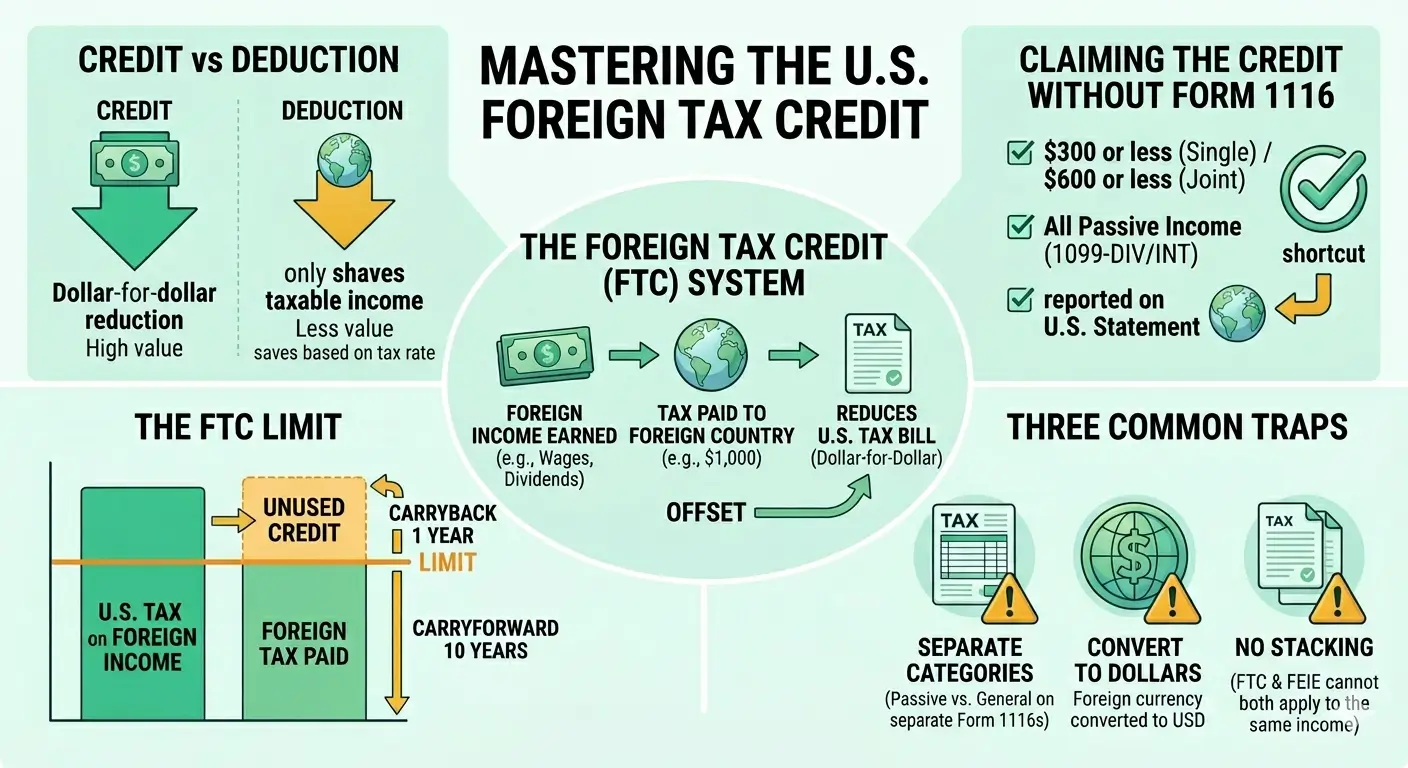
Table of Contents
1. What Is the Foreign Tax Credit?
The United States taxes worldwide income. If you’re a citizen, green card holder, or tax resident, money you earn abroad goes on your U.S. return — and the country where you earned it usually taxed it already. Without some kind of relief, that’s the same income taxed twice.
The Foreign Tax Credit is the relief. It takes the income tax you paid to a foreign country and subtracts it straight from your U.S. tax. The key word is offset, not exemption. You still report all of your worldwide income to the IRS. The credit then pulls the foreign tax back off the U.S. bill.
One thing to know going in. Tax software built around U.S.-only returns often doesn’t walk you through foreign income or this credit at all. If you file your own return, this is a spot worth slowing down on.
2. Credit or Deduction — Which Should You Take?
Foreign income tax can go on your return two ways, and the difference is real money.
A credit cuts your U.S. tax dollar for dollar. Pay $1,000 abroad, knock $1,000 off your U.S. tax. A deduction only shaves your taxable income, so what you actually save is your tax rate — at 22%, that same $1,000 is worth about $220.
Bottom line: For most people the credit wins, and not by a little. You claim the credit on Form 1116. The deduction goes on Schedule A as an itemized deduction. You choose one or the other each year — you can’t split the same foreign tax between both.
3. Do You Have to File Form 1116?
Small amounts get a shortcut. Meet all three of these and you can claim the credit right on Schedule 3, no Form 1116 required:
- All of your foreign income is passive — mostly interest and dividends.
- That income and the foreign tax were reported to you on a U.S. payee statement, like a 1099-DIV or 1099-INT.
- Your creditable foreign tax is $300 or less ($600 or less for married filing jointly).
The trade-off: Take the shortcut, and you give up the carryback and carryover for that year. If your foreign tax bounces around near the limit, filing Form 1116 to keep those carryover rights can be worth the extra page.
4. The Limit — and Why You Might Not Get It All Back
The credit has a ceiling. You can only claim up to the U.S. tax that falls on your foreign income. The formula behind it is your U.S. tax multiplied by your foreign-source taxable income divided by your total taxable income.
The squeeze happens when the foreign country’s rate runs higher than the U.S. rate on that income. You paid more abroad than the U.S. ceiling allows, so part of your credit can’t be used this year. It doesn’t disappear. You carry it back one year, then forward up to ten. A lot of people assume the unused part is simply gone. It isn’t.
5. Three Things That Trip People Up
Categories stay separate. Form 1116 sorts foreign income into categories — passive (interest, dividends) and general (wages and most active income) are the two you’ll see most. Each category gets its own Form 1116, and the limit is figured separately for each. Pile everything onto one form and the math breaks.
Convert to dollars. Foreign tax paid in another currency has to be reported in U.S. dollars. Most individuals use the exchange rate on the date the tax was paid or withheld.
The FTC and the FEIE don’t stack. Exclude foreign wages under the Foreign Earned Income Exclusion, and you can’t also claim a foreign tax credit on that same excluded income. Which combination comes out ahead depends on your numbers.
EA Insight
In practice, the Foreign Tax Credit rarely shows up as a big number. What I see far more often is the small one that gets left behind. Someone holds an international fund or a few foreign dividend stocks through a U.S. brokerage, and there it is — a modest foreign tax figure sitting in a box on the 1099-DIV. The software didn’t ask about it, the taxpayer didn’t notice it, and the credit went unclaimed. It’s seldom dramatic. It’s just money left on the table, year after year.
A couple of other patterns are worth flagging. People who do pay a higher foreign rate sometimes assume that when the credit doesn’t fully land in one year, the rest is lost. It carries forward up to ten years. And once in a while I see passive and general income crammed onto a single Form 1116, which throws off the limit calculation.
None of this is exotic. If you have foreign income and any foreign tax sitting on it, the safe move is to have that slice of the return looked at once. Entering a number and entering it correctly aren’t the same thing.
Frequently Asked Questions
Will I get all of my foreign tax back?
Not always. The credit is capped at the U.S. tax on your foreign income. If a higher foreign rate leaves some unused, it carries back one year and forward up to ten — it isn’t lost.
Do I always have to file Form 1116?
No. If all your foreign income is passive, it’s reported on a 1099, and your foreign tax is $300 or less ($600 or less for joint filers), you can claim it directly on Schedule 3 and skip the form. Taking that shortcut waives your carryover for that year, though.
Credit or deduction — which is better?
Usually the credit. It cuts your tax dollar for dollar, while a deduction only reduces taxable income. There are rare cases where the deduction works out better, so it’s worth comparing both for your situation.
Can I use the Foreign Tax Credit and the Foreign Earned Income Exclusion together?
Not on the same income. Income you exclude under the FEIE can’t also generate a foreign tax credit. Many people who have both wages and investment income abroad exclude some wages and take the credit on the rest. The numbers decide.
What happens to credit I can’t use this year?
It carries back one year, then forward up to ten. Unused foreign tax credit is not forfeited — you can apply it in a year when your limit leaves room.
Official Resources
Disclaimer: This article is for educational and informational purposes only and does not constitute tax, legal, or financial advice. Tax laws and regulations change frequently. Always consult a qualified tax professional for advice specific to your individual situation. eataxwise.com and its author are not responsible for any actions taken based on the information provided in this article.