What Is a 1099-K?
Understanding Payment Card and Third-Party Network Reporting
If you sell goods or services through payment apps like PayPal, Venmo, or Cash App — or accept credit card payments from customers — you may receive a Form 1099-K. This guide explains what the form reports, who receives it, the current federal reporting threshold, and how to report the income on your tax return.
Key Takeaways
- Form 1099-K reports payments you received for goods or services through payment cards, payment apps, or online marketplaces.
- The current federal threshold for third-party settlement organizations (TPSOs) is over $20,000 in payments and more than 200 transactions — permanently restored by the One Big Beautiful Bill Act.
- Credit and debit card processors may issue a 1099-K regardless of amount or number of transactions.
- Platforms may still send you a 1099-K even if you fall below the federal threshold — and some states have thresholds as low as $600.
- Receiving a 1099-K does not mean the entire amount is taxable. Personal reimbursements, gifts, and items sold at a loss are generally not taxable.
- Whether or not you receive a 1099-K, all income from selling goods or services must be reported on your tax return.
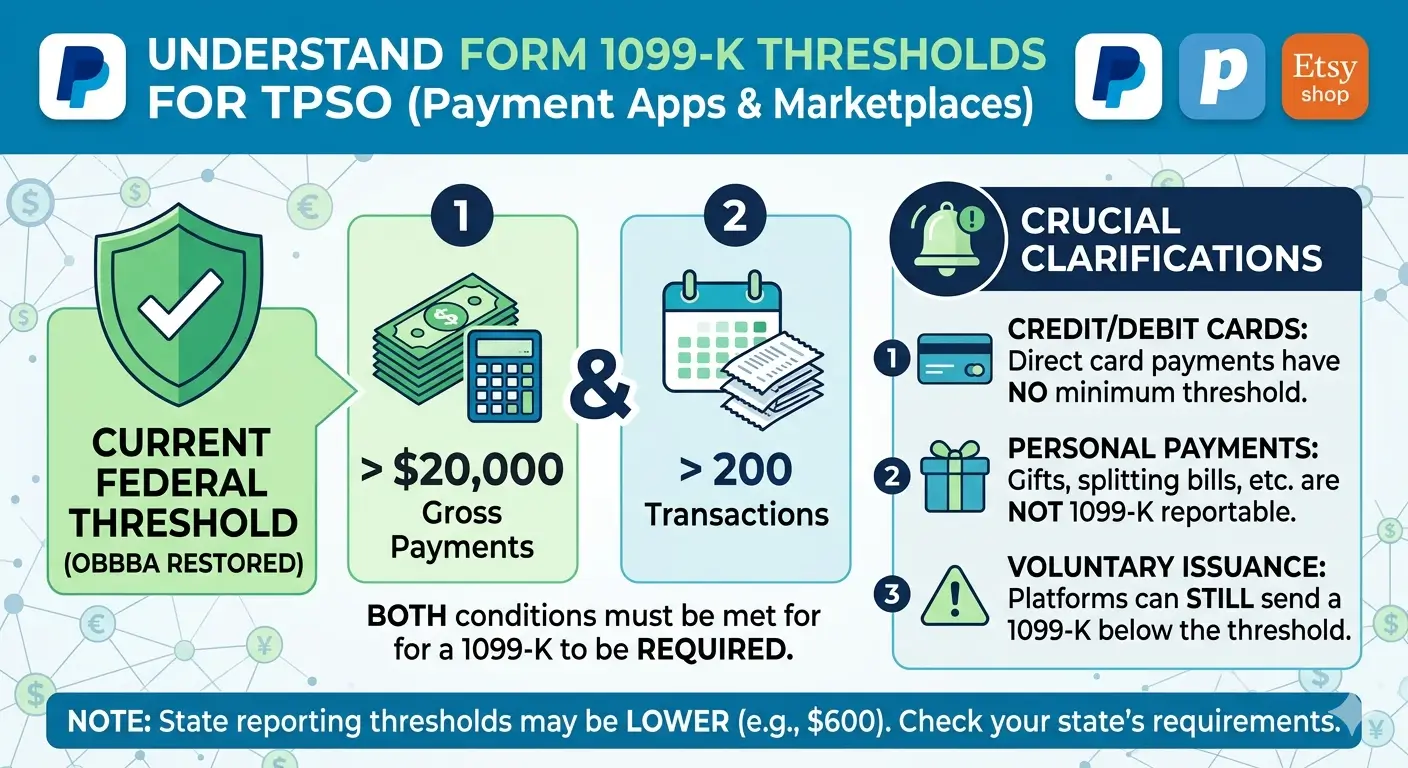
Table of Contents
- What Is Form 1099-K?
- Who Sends Form 1099-K?
- What Is the Current 1099-K Reporting Threshold?
- State Thresholds May Be Lower
- What Does Form 1099-K Report?
- How to Report 1099-K Income on Your Tax Return
- What If Your 1099-K Is Wrong?
- 1099-K vs. 1099-NEC — What’s the Difference?
- Common Mistakes to Avoid
- EA Insight
- Frequently Asked Questions
What Is Form 1099-K?
Form 1099-K, Payment Card and Third-Party Network Transactions, is an IRS information return filed by payment settlement entities (PSEs). It reports payments you received for goods or services through two types of channels:
- Payment cards — credit cards, debit cards, and stored-value (gift) cards
- Third-party payment networks — payment apps (PayPal, Venmo, Cash App), online marketplaces (Etsy, eBay, Amazon), and similar platforms
One critical detail: the form reports gross payments — the total dollar amount before any deductions for processing fees, refunds, shipping costs, or discounts. This means the amount shown on your 1099-K may be significantly higher than your actual taxable income.
Payment settlement entities must send you a copy of your 1099-K by January 31 of the following year. The IRS also receives a copy, which is why accurate reporting matters.
Who Sends Form 1099-K?
Two types of entities issue Form 1099-K:
1. Payment card companies. These include merchant acquirers, processors, and companies like Square or Stripe that process credit, debit, or gift card transactions on your behalf. There is no minimum dollar amount or transaction count — if your customers pay you by card, the processor may send a 1099-K for any amount.
2. Third-party settlement organizations (TPSOs). These are payment apps such as PayPal, Venmo, and Cash App, as well as online marketplaces like Etsy, eBay, and Amazon. TPSOs are subject to a federal reporting threshold — explained in the next section.
Understanding this distinction matters because many people assume all 1099-K forms follow the same threshold rules. They do not.
What Is the Current 1099-K Reporting Threshold?
For third-party settlement organizations (TPSOs), the current federal reporting threshold requires both of the following conditions to be met:
| Requirement | Threshold |
|---|---|
| Total gross payments | Over $20,000 |
| Number of transactions | More than 200 |
If only one condition is met — for example, $25,000 in payments but only 150 transactions — the TPSO is generally not required to file a 1099-K.
How the Threshold Got Here
The 1099-K reporting threshold has changed multiple times in recent years:
| Period | TPSO Threshold | What Happened |
|---|---|---|
| Before 2022 | $20,000 + 200 transactions | Original rule (since 2008) |
| 2021 (ARPA) | $600, no transaction minimum | Congress lowered it; IRS delayed implementation |
| Tax year 2024 | $5,000 (transitional) | IRS phased-in approach |
| July 2025 (OBBBA) | $20,000 + 200 transactions | Original threshold permanently restored |
The One Big Beautiful Bill Act (OBBBA), signed into law on July 4, 2025, retroactively repealed the lower thresholds set by the American Rescue Plan Act. The $20,000-and-200-transaction rule is now treated as if it had never changed.
Important: Even with the higher federal threshold, platforms may voluntarily issue a 1099-K for amounts below $20,000. The IRS explicitly permits this. Receiving a form does not automatically mean the income is taxable — but it does mean the IRS has a copy.
State Thresholds May Be Lower
Several states set their own 1099-K reporting thresholds that are significantly lower than the federal standard. Even if you do not meet the federal requirement, you may still receive a 1099-K based on your state’s rules.
| Threshold | States |
|---|---|
| $600 | DC, Maryland, Massachusetts, Montana, North Carolina, Vermont, Virginia |
| $1,000+ | Illinois ($1,000 + 4 transactions), New Jersey ($1,000) |
Note: State reporting requirements change frequently. Always check your state’s tax agency website for the most current thresholds before filing. Many payment platforms handle state-level filings automatically, but you should not assume this — verify with the platform and your state.
What Does Form 1099-K Report?
Here are the key boxes on Form 1099-K and what each one means:
| Box | Description |
|---|---|
| Box 1a | Gross amount of all reportable payment transactions (before fees, refunds, or adjustments) |
| Box 1b | Card-not-present transactions (typically online, phone, or catalog sales) |
| Box 2 | Merchant category code (MCC) — classifies your type of business |
| Box 3 | Number of payment transactions (excludes refunds) |
| Box 4 | Federal income tax withheld (backup withholding, if applicable) |
| Box 5a–5l | Monthly gross amounts (January through December) |
| Boxes 6–8 | State tax information (state name, state ID number, state income tax withheld) |
The most important number is Box 1a — the gross payment amount. Keep in mind that this figure includes everything: taxable sales, refunds, returns, and even personal transactions that may have been incorrectly classified. That is why comparing your 1099-K to your own records is essential.
How to Report 1099-K Income on Your Tax Return
Where you report 1099-K income depends on the type of payments you received:
Business Income (Freelancers, Gig Workers, Self-Employed)
Report gross receipts on Schedule C (Form 1040), Line 1. Deduct business expenses in Part II of Schedule C. The 1099-K shows gross payments — it does not account for your costs, so you will need your own records to determine your actual profit.
Personal Items Sold
If you sold personal items (furniture, clothing, electronics) through a marketplace:
- Sold at a gain: Report the profit on Form 8949 and Schedule D.
- Sold at a loss: Report on Form 8949 to zero out the reported income. A loss on the sale of a personal item is not tax-deductible — but you also do not owe tax on it.
Hobby Income
Report gross hobby income on Schedule 1 (Form 1040) as other income. Under current tax law, hobby expenses are generally not deductible.
What If Your 1099-K Is Wrong?
If the information on your 1099-K is incorrect — wrong amount, wrong name, or personal transactions misclassified as business payments — take these steps:
- Compare the form to your own records. Check bank statements, app transaction histories, and invoices.
- Contact the filer. The filer’s name and phone number appear in the upper left corner of the form. Request a corrected 1099-K.
- If a corrected form arrives in time, use it when filing your return.
- If a corrected form does not arrive in time, report the incorrect amount on the entry space at the top of Schedule 1 (Form 1040), then adjust it so you only pay tax on the correct amount.
- If the filer refuses to correct the form, contact the IRS for further guidance.
A common source of errors: personal payments — such as splitting a dinner bill or receiving a gift from a friend — being classified as business transactions within a payment app. To reduce this risk, always mark personal transfers correctly in the app when possible.
1099-K vs. 1099-NEC — What’s the Difference?
These two forms are easy to confuse, especially for freelancers and independent contractors. Here is how they differ:
| 1099-K | 1099-NEC | |
|---|---|---|
| Issued by | Payment platform or card processor | The business that paid you (client/payer) |
| Reports | Payment card and third-party network transactions | Nonemployee compensation (direct payments) |
| Federal threshold | $20,000 + 200 transactions (TPSO) | $600 (tax year 2025); $2,000 (starting tax year 2026) |
| Common recipients | App-based sellers, online marketplace sellers, gig workers | Freelancers, consultants, independent contractors |
Watch for overlap: If a client pays you through PayPal, you could receive both a 1099-K from PayPal and a 1099-NEC from the client. You only report the income once — this is where keeping detailed records of each payment becomes critical.
Note that the 1099-NEC reporting threshold changes from $600 to $2,000 starting with the 2026 tax year under the One Big Beautiful Bill Act. For tax year 2025 (filed in early 2026), the $600 threshold still applies.
Common Mistakes to Avoid
Treating the 1099-K gross amount as your taxable income. The gross amount in Box 1a includes refunds, processing fees, non-taxable personal transactions, and shipping charges. Your actual taxable income is usually lower. Always reconcile the form with your own records.
Assuming no 1099-K means no reporting obligation. Whether or not you receive a form, all income from selling goods or services must be reported on your tax return. The IRS has made this point repeatedly — reporting requirements and tax obligations are two separate things.
Mixing personal and business transactions in payment apps. When you use the same account for personal transfers and business payments, personal items can be incorrectly reported as income. Use the “friends and family” or “personal” option for non-business transfers whenever possible.
Filing without verifying an incorrect 1099-K. If the amount on your 1099-K does not match your records, do not simply report whatever the form says. Contact the filer first to request a correction.
EA Insight
More and more people are running several side gigs at once — driving for a rideshare app, reselling online, picking up freelance work on the weekends. So they walk in at tax time with a stack of forms: a 1099-K from one platform, a 1099-NEC from a client, sometimes a 1099-MISC on top of that. The trouble starts when they look at the big number in Box 1a of the 1099-K and assume that is what they earned.
It isn’t. Box 1a is gross — platform fees, customer refunds, shipping, and the cost of inventory they bought to resell are all baked into that figure. When someone doesn’t keep expense records, they can’t back any of it out, so they end up reporting far more profit than they actually made. That is real money paid in tax on income that was never really income. The fix is unglamorous but it works: save every fee statement, refund record, and receipt as you go, not in April.
The opposite mistake is just as common. Someone never receives a 1099-K — maybe they stayed under the threshold — and decides the income doesn’t need to be reported. The form is a paperwork trigger for the platform, not the thing that creates the tax. If you earned it, you report it, form or no form. The IRS has the matching data either way, and a CP2000 notice is how that gap usually surfaces.
Frequently Asked Questions
Do I have to pay taxes on my 1099-K?
Not necessarily. Receiving a 1099-K does not mean the entire amount is taxable. Whether you owe taxes depends on what the payments were for. Business income is taxable. Personal items sold at a loss are not. Gifts and personal reimbursements from friends and family are not taxable either.
What if I sold personal items at a loss?
If you sold a personal item for less than you originally paid, you do not owe tax on that sale. But you cannot deduct the loss either. Report the transaction on Form 8949 to show the IRS the sale price and your original cost, effectively zeroing out the reported income.
Will Venmo or PayPal send me a 1099-K for personal payments?
Personal payments — gifts, reimbursements for shared expenses, and money sent between friends and family — are not reportable on Form 1099-K. If a payment is incorrectly categorized as a goods-or-services transaction within the app, it could be included. Always use the “friends and family” or “personal” option for non-business transfers.
What happens if I don’t report my 1099-K income?
The IRS receives a copy of every 1099-K issued. If you do not report the income shown on the form, the IRS may send you a CP2000 notice proposing additional tax, interest, and potentially penalties based on the unreported amount.
Can I receive a 1099-K even if I’m below the $20,000 threshold?
Yes. The $20,000-and-200-transaction threshold applies only to TPSOs (payment apps and online marketplaces). Payment card processors have no minimum threshold. Platforms may also voluntarily send a 1099-K for lower amounts, and some states require reporting at much lower thresholds — as low as $600.
Related Articles
Official Resources
Disclaimer: This article is for informational and educational purposes only and does not constitute tax, legal, or financial advice. Tax laws and regulations change frequently. While every effort has been made to ensure accuracy, readers should consult a qualified tax professional for advice specific to their individual circumstances. eataxwise.com and its author assume no liability for actions taken based on the information provided here.
Pingback: What Is a 1099-DA?
Pingback: What Is a 1099-MISC?
Pingback: What Is a 1099-INT?
Pingback: What Is a Tax Refund?
Pingback: Got Your First 1099 from Uber? An EA Breaks It Down
Pingback: Content Creator Tax Deductions: The Rules That Matter
Pingback: What Is Estimated Tax? Complete 2026 Guide