
No, the EA Exam Passing Score Isn’t 105 Anymore
The exam moved to a new administrator in 2026, and the scoring changed with it. Here’s what’s actually true now — and what to ignore on older pages.
This article reflects the 2026 testing cycle. EA exam dates, fees, and procedures change from year to year — always confirm the current details on the IRS and PSI pages before you register.
Key Takeaways
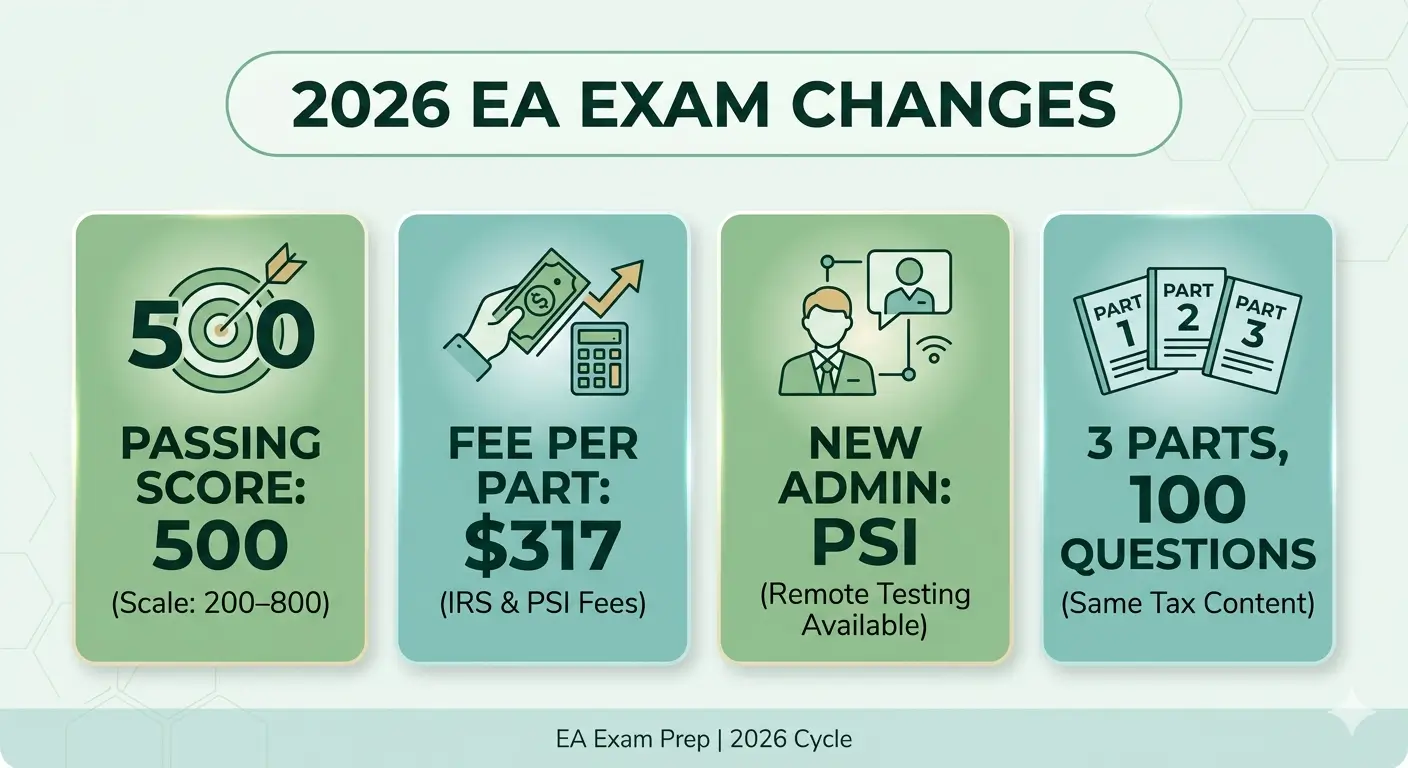
- The EA exam passing score is now 500 on a 200–800 scale. The old “105 to pass” no longer applies.
- PSI Services replaced Prometric as the testing administrator on March 1, 2026.
- The fee is $317 per part. Older pages showing $267 or $350 are out of date.
- The exam content didn’t change — three parts, same subjects, based on prior-year tax law.
- U.S. testing runs July 1, 2026 through February 28, 2027. International remote testing opens September 1, 2026.
- You need a PTIN before you can schedule, and you file Form 23 after passing all three parts.
Table of Contents
1. The Score Change — Why 105 Is Gone
Start with the one correction that matters most. If a study guide, a forum post, or an old blog told you that 105 is the score you need, set that number aside. It’s outdated.
As of the 2026 cycle, the EA exam is scored on a scale from 200 to 800, and the passing score is 500. The old 40-to-130 scale — where 105 was the bar — retired when the exam changed hands. The IRS confirms the new figure in its official Enrolled Agent FAQ.
Why does the wrong number keep turning up? A lot of material simply hasn’t been updated. Encyclopedia entries, older prep books, study-group threads from a few years back — many still print 105. Seeing it doesn’t mean you misread something. It means the source is behind.
One thing the 500 does not mean: it isn’t a count of correct answers, and it isn’t “get 62.5% and you pass.” It’s a scaled score. Each part has 100 questions, but only 85 count toward your result — the other 15 are unscored items, and you won’t know which. Your correct answers get converted onto the 200–800 scale so difficulty stays fair across exam versions. Don’t try to back into it as a simple percentage.
2. What Else Changed in 2026
The score scale wasn’t the only thing to move. The bigger structural news is that the exam has a new administrator.
On March 1, 2026, PSI Services took over from Prometric, which had run the exam for about two decades. Here’s what that shift means in practice.
| Item | Before (Prometric) | Now (PSI, 2026–) |
|---|---|---|
| Administrator | Prometric | PSI Services |
| Fee per part | $267 | $317 |
| Score scale | 40 – 130 | 200 – 800 |
| Passing score | 105 | 500 |
| Exam day format | 2 sections, one 15-min break | 3 sections, two 10-min breaks |
| Remote testing | None | Available (PSI remote proctoring) |
| Registration opens | — | May 1, 2026 |
| U.S. testing window | — | Jul 1, 2026 – Feb 28, 2027 |
| International testing | — | Remote only, from Sep 1, 2026 |
A few of these are worth a second look.
Remote testing is now an option
Before, you went to a test center. U.S. candidates can now choose a PSI center or a remote, proctored session at home. International candidates test remotely only, starting September 1, 2026. If you’re preparing from outside the U.S., that’s a real change in your favor.
The fee went up — and the number you saw might be wrong either way
It’s $317 per part now, up from $267. You may also run into $350 on some pages — a figure that circulated during the transition before the fee settled. The current amount is $317, split into a $66 IRS portion and a $251 PSI portion. Three parts means paying it three times, so passing on the first attempt matters more than it used to.
The 2026 gap was unusually long
The EA exam normally closes each March and April so the questions can be rewritten for new tax law. In 2026 the vendor switch stretched that pause. Prometric wrapped up at the end of February, and PSI didn’t open testing until July 1. That’s longer than the usual two-month blackout, so this year’s calendar looks different from a normal cycle.
3. What Didn’t Change
Here’s the reassuring part. The scoring moved and the vendor moved, but what the exam asks did not.
It’s still three parts, still the same subjects:
- Part 1 — Individuals
- Part 2 — Businesses
- Part 3 — Representation, Practices & Procedures
If you already started studying, the vendor change isn’t a reason to stop. Your material on the actual tax content still holds. An older Prometric-era guide will read out of date on logistics — the score, the fee, the booking steps — but the tax law it teaches is the same law the exam tests.
One detail worth keeping straight: the EA exam tests the prior year’s tax law. The 2026 exam is built on the law as it stood on December 31, 2025. That’s why the questions get rewritten each spring. When you study, make sure your materials match the exam’s base year, not whatever shifted during this filing season.
4. If You’re Starting From Zero
Starting with nothing in place? The path is shorter than it looks.
1. Get a PTIN
A PTIN is the number anyone needs to be paid for preparing tax returns, and you need one before you can schedule the exam. You apply on the IRS website in about fifteen minutes. The 2026 fee is $18.75, and you now log in through ID.me identity verification. Worth knowing early: even after you become an EA, the PTIN has to be renewed every year to stay active. The credential isn’t a one-and-done.
2. Register and schedule with PSI
Once your PTIN is ready, you create an account on the PSI portal and book your exam. Registration opened May 1, 2026; testing starts July 1. When a long blackout ends and everyone books at once, early slots fill fast — so schedule sooner rather than later.
3. Pick your order
You don’t have to take the parts in sequence. Most people are better off starting with Part 1, Individuals. It’s the closest to everyday life, the concepts are intuitive, and it’s a gentle way to get used to how the exam asks its questions.
4. Finish all three within three years
Once you pass your first part, you have three years to clear the other two. Within a single testing window, you can attempt one part up to four times. There’s room to move at your own pace — no need to rush, no reason to stall.
5. File Form 23 — passing isn’t the finish line
Passing all three parts doesn’t make you an EA on its own. You file Form 23 within one year of passing the third part, pay the $140 enrollment fee, and clear a suitability check that reviews your own tax compliance and background. Then the credential is yours.
EA Insight
As someone who passed all three parts and now prepares returns every day, the mistake I see most often right now has nothing to do with tax law. It’s people studying from the wrong year’s information — chasing a 105 that no longer exists, budgeting for a fee that already changed, or following booking steps from the old vendor.
Two habits keep you out of trouble. Check the score, fee, and dates against the IRS FAQ and PSI directly before trusting any third-party page — this one included. And match your study material’s base year to the exam you’re actually sitting for. The content is stable; it’s the logistics that just had their biggest shake-up in twenty years.
Frequently Asked Questions
Is the EA exam passing score still 105?
No. As of the 2026 cycle, the passing score is 500 on a 200–800 scaled-score range. The 105 figure belonged to the old 40–130 scale and no longer applies.
Who administers the EA exam now?
PSI Services. PSI took over from Prometric on March 1, 2026, after Prometric had run the exam for roughly twenty years.
How much does each part cost in 2026?
$317 per part, up from $267. Some pages still show $267 or a transitional $350 — the current fee is $317.
Did the exam content change with the new vendor?
No. It’s still three parts — Individuals, Businesses, and Representation, Practices & Procedures — covering the same subjects, based on the prior year’s tax law. Only the scoring, fee, and logistics changed.
Can I take the EA exam remotely?
Yes. U.S. candidates can choose a PSI test center or remote proctoring. International candidates test remotely only, beginning September 1, 2026.
Do I need a PTIN before scheduling?
Yes. You must hold a valid PTIN before you can register and schedule with PSI. You can apply for one on the IRS website.
Official Resources
Disclaimer: This article is for educational and informational purposes only and does not constitute tax, legal, or financial advice. EA exam dates, fees, and administrator details change frequently — always confirm the latest information on the IRS “Enrolled Agent News” page and the PSI website before registering. eataxwise.com and its author are not responsible for any decisions made based on the information in this article.