
Does Having a Baby Open a Trump Account?
Early this filing season, a couple who’d had a son in 2025 came in for their first return as parents. Both U.S. citizens. While we worked through the return, they opened a Trump Account for their boy — and they opened with the question I now hear from almost every new parent: “He gets the $1,000 automatically, right?” He didn’t. And the gap between “we had a baby” and “the money is set” is where families lose this.
Key Takeaways
- The $1,000 Trump Account seed is not automatic. A parent has to make the election on Form 4547 — no election, no account, no $1,000.
- For a newborn, the real bottleneck is the Social Security number. The election needs the child’s SSN issued first, and the card can run late.
- If you already filed without Form 4547, you haven’t lost the money — but you can’t bolt it onto an amended return. You file the form separately, and the election window runs for years.
- Filing Form 4547 isn’t the finish line. The account still has to be activated before any money moves.
- If the goal is college, a 529 is usually the stronger account, because qualified 529 withdrawals come out tax-free.
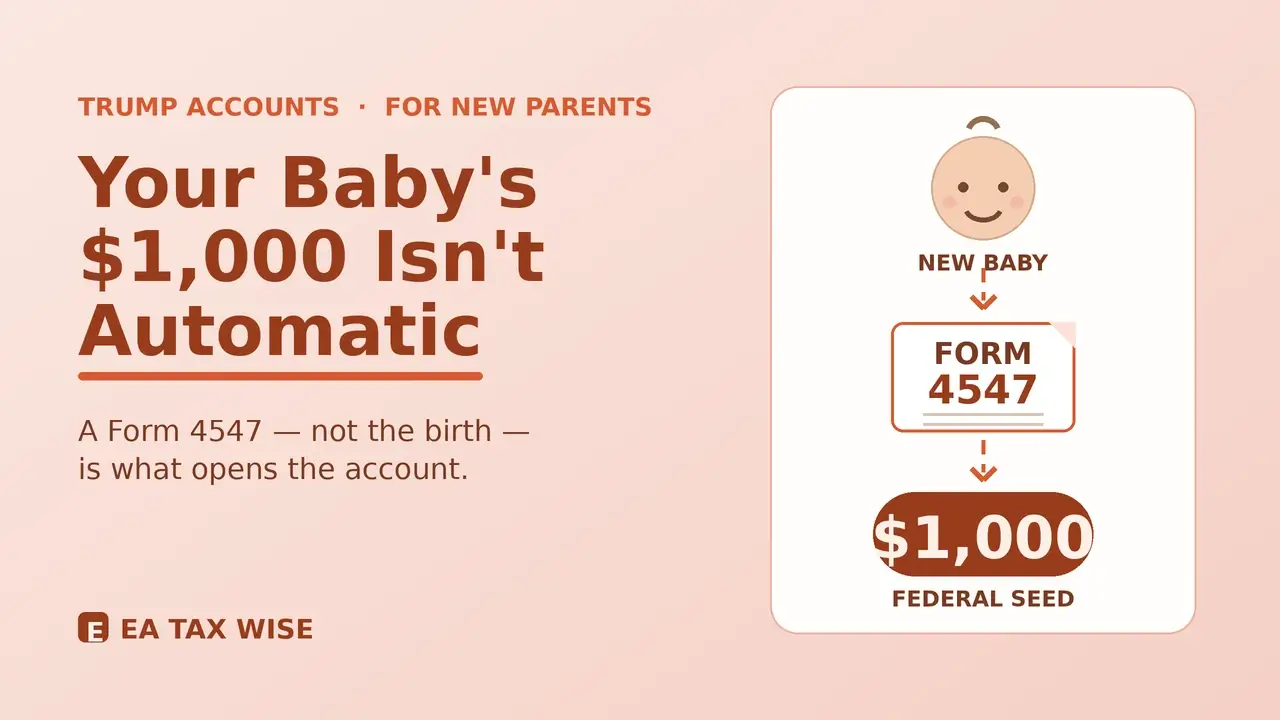
Table of Contents
- 1. Does Having a Baby Automatically Open the Account?
- 2. What Do I Check Before Anything Else?
- 3. I Already Filed. Is the $1,000 Coming With My Refund?
- 4. We’re Saving for College — Should I Load Money In?
- 5. Who Controls the Account at 18?
- 6. What Should You Do Today?
- 7. Frequently Asked Questions
- 8. Related Articles
- 9. Official Resources
1. Does Having a Baby Automatically Open the Account?
No. A parent has to claim it.
The $1,000 the government puts into a Trump Account isn’t a check that lands because you had a child. It’s a seed that posts only after a parent makes a specific election — Form 4547 — to open the account in the child’s name. No election, no account. No account, no seed.
This is the part that catches people. They picture it like the Child Tax Credit, something that rides along with the return on its own. It doesn’t. A 2025 baby doesn’t receive $1,000 for existing — a parent has to claim it, in writing, on the right form. The couple in my office had done exactly that, so they were fine. Plenty of families I talk to assume it’s handled when nothing’s been filed at all.
| What new parents assume | What actually has to happen |
|---|---|
| Having the baby opens the account | A parent files the election (Form 4547) |
| The $1,000 just shows up | The seed posts only after a valid election |
| Any relative can set it up | A parent or guardian opens it; others may contribute |
| The baby’s SSN is a given | The election needs the child’s SSN first — and it can lag |
Timing matters here too. Money can’t move into these accounts before July 4, 2026. Open the election ahead of that date and you’re in line for the seed when funding begins. Skip it, and there’s nothing waiting in line at all.
2. What Do I Check Before Anything Else?
The baby’s Social Security number — not the money, not the fund.
This is the first thing I look at, and it surprises people. The election needs the child’s SSN issued before the election date. For a newborn, that’s the whole ballgame. Most parents check the SSA box on the hospital birth paperwork and the card arrives a few weeks later. Some skip that box. Some cards run late. I’ve watched one disappear in a move.
So when a family like this sits down, I don’t reach for a fund brochure. I ask whether the baby’s number has come through, and when. The order I work in goes like this:
- Is the child’s SSN actually issued?
- Does the child meet the election requirements (citizenship, birth year)?
- Did the election actually get filed and accepted?
Only then do we talk about the $1,000. If there’s no number in hand, step one stops everything — and the money sits on a table you can’t reach, no matter how eligible the child is.
3. I Already Filed. Is the $1,000 Coming With My Refund?
Not on its own. But you haven’t lost it.
This is the mix-up I see most. A return goes in early, fast and clean, and the parent assumes the $1,000 rides along with the refund. If Form 4547 wasn’t part of that return, there’s no account for the seed to land in. Being eligible and being enrolled are two different things.
The fix has one wrinkle worth knowing. You can’t amend the return you already filed and staple the form to it — Form 4547 doesn’t attach to an amended return. You file it on its own instead: by mail, through your IRS online account, or through the election portal. The deadline is more forgiving than people expect, too. The window to claim the pilot seed runs all the way through the end of the year your child turns 17.
One more piece. Filing Form 4547 isn’t the last step. The account has to be activated separately before any money moves. So “I filed, so I’m done” is the trap — check that the election went through, and that the activation instructions actually reached you.
4. We’re Saving for College — Should I Load Money In?
For education alone, a 529 is usually the stronger account.
This runs against what the account’s name suggests, so I say it plainly. Qualified 529 withdrawals come out completely tax-free. Trump Account growth comes out taxed as ordinary income down the road. For a pure college goal, that’s not a close call. So for a family saving for tuition, I lay it out this way — make the election, take the $1,000, fund the 529 for the college money, and treat the Trump Account as a small long-horizon extra. Open it because the seed is real. Don’t mistake it for the better college bucket. (The full side-by-side — limits, taxes, withdrawal rules — lives in the basic guide linked below.)
One caution if you plan to put in real money of your own: contributions above the annual gift tax exclusion can bring gift tax reporting into play. Worth checking before you fund a large amount.
5. Who Controls the Account at 18?
The child does — fully.
At 18, control of the account passes to your child. They can hold it, convert it, or empty it. A 529 keeps the parent as owner; a Trump Account doesn’t. It’s not a 2026 problem. But before a family pours money in, it’s worth one honest conversation about who’s holding the wheel in eighteen years.
6. What Should You Do Today?
Find your child’s Social Security card and check the issue date.
Without that number, you can’t even start the election. For a family with a new baby, it’s the first document to confirm — before the fund, before the contribution, before anything. If you can’t find the card, or never requested one, that’s the only thing that matters right now. Request it. The account, the election, and the $1,000 all wait behind that number.
Frequently Asked Questions
Is the $1,000 Trump Account contribution automatic for a newborn?
No. A parent or guardian has to make the election on Form 4547. Eligible children don’t receive the seed unless that election is filed.
My baby doesn’t have a Social Security number yet. Can I still claim it?
Not until the SSN is issued. The election requires the child’s Social Security number first, so requesting the card is the step that unlocks everything else.
I already filed my taxes without the form. Did I miss the $1,000?
No. You can file Form 4547 separately — it isn’t tied to your return, and it can’t be added to an amended return. The window to claim the pilot seed runs through the end of the year your child turns 17.
Is a Trump Account better than a 529 plan for college?
For education specifically, a 529 is usually stronger, because qualified 529 withdrawals are tax-free while Trump Account earnings are taxed as ordinary income. Many families use both.
Official Resources
Disclaimer: This article is for educational and informational purposes only and does not constitute tax, legal, or financial advice. Tax laws and program rules change frequently, and additional Trump Account guidance is expected. Always confirm current rules with official IRS sources or consult a qualified tax professional for advice specific to your situation. eataxwise.com and its author are not responsible for any actions taken based on this article.