
What an ITIN Can’t Do: The Identification-Number Traps on EA Exam Part 1
The exam doesn’t ask what an ITIN is. It asks what number opens which door — and that’s where test-takers lose points.
This article reflects the 2026 testing cycle (tax law through December 31, 2025; figures for tax year 2025). Exam details and tax figures change — always confirm the current details on the IRS and PSI pages before you file or register.
TRY IT FIRST — SAMPLE QUESTION 1 OF 5
David and his wife file with ITINs and support two children, who also have ITINs. Their earned income falls within the EITC range. Can they claim the EITC?
(A) Yes — if they meet the income test, an ITIN is fine.
(B) Yes — as long as at least one child has an SSN.
(C) No — the EITC requires the taxpayer, spouse, and every qualifying child to have SSNs, and an ITIN filer can’t claim it.
(D) No — the EITC is only for the self-employed.
Pick your answer and hold it. Everything you need to be sure is in the next three sections — the answer and its explanation come right after.
Key Takeaways
- The Child Tax Credit ($2,200) requires the child to have a work-authorized SSN — a parent’s SSN is not enough on its own.
- An ITIN child can’t get the CTC, but still brings the $500 Credit for Other Dependents — not “nothing.”
- CTC and EITC split on the spouse rule: CTC needs one spouse with an SSN on a joint return; EITC needs both spouses and every child.
- An ITIN expires after three consecutive years of non-use — but appearing on someone else’s return resets the clock.
- An ITIN is tax-only: it does not authorize work, grant immigration status, or provide Social Security benefits.
Table of Contents
1. Where Test-Takers Lose Points
Open EA Exam Part 1, Domain 1, and you’ll hit a taxpayer-identification-number question — you just did, above. Most candidates lose points in the same spot, and it isn’t on the definition. “What is an ITIN?” is something the IRS instructions already explain better than any prep blog can. What the exam actually tests is narrower and meaner: which number unlocks which benefit.
Here’s a second question in the exact shape the test loves. A married couple both hold work-authorized SSNs. They support their 6-year-old child. The child has no SSN — only an ITIN. What can they claim for that child? A lot of candidates pick “the full $2,200 Child Tax Credit, because the parents have SSNs,” or “the CTC, claimed with the ITIN.” Both are wrong. The answer is the $500 Credit for Other Dependents. The CTC requires the child to have a work-authorized SSN — the parents’ numbers don’t carry the credit across.
That’s the pattern underneath the whole section — including the EITC question you’re still holding. The exam rarely asks ITIN’s definition. It asks what an ITIN can’t do.
2. The Four Numbers, Fast
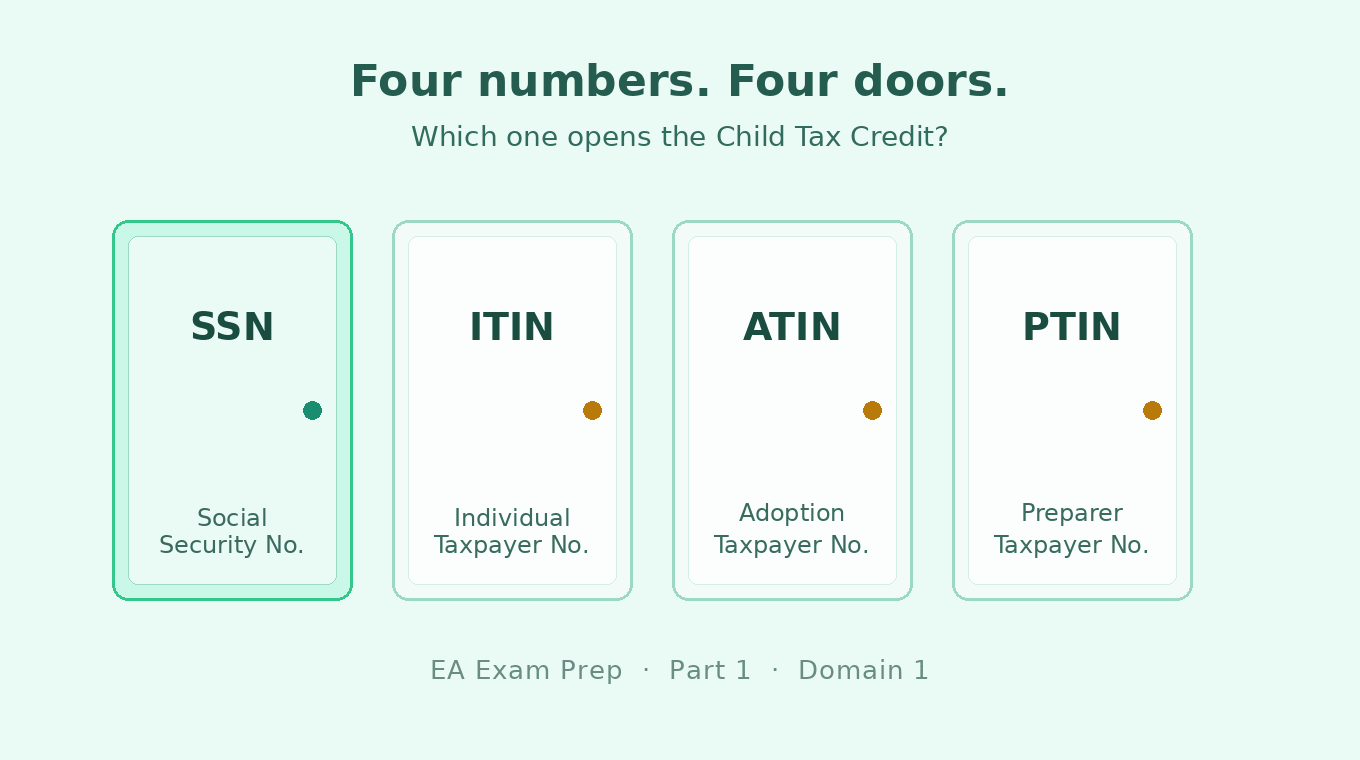
You need just enough of the floor to see the traps standing on top of it. Four numbers:
- SSN — issued by the Social Security Administration, for citizens and work-authorized people. The full-purpose number.
- ITIN — issued by the IRS for someone with a filing obligation who can’t get an SSN. Begins with 9; applied for on Form W-7.
- ATIN — a temporary number for a child being adopted whose SSN isn’t available yet.
- PTIN — the paid preparer’s number, not the taxpayer’s. The exam mixes this one in to bait you.
The one fact about an ITIN worth burning into memory: it is tax-only. It does not authorize work, grant immigration status, or make anyone eligible for Social Security benefits. That sounds like a plain definition, but “an ITIN proves my status / lets me work” is one of the most common wrong answer choices in the section. The exam writes the misconception straight into option (A).
3. Which Number Opens Which Door
Half the traps in this section live in one small table. Read it as doors, not definitions — and watch the EITC row, because it settles the opening question.
| Tax Item | SSN Required? | ITIN OK? |
|---|---|---|
| File a federal return | No | Yes |
| Child Tax Credit ($2,200) | Yes — child + taxpayer (one spouse if MFJ) | No |
| Credit for Other Dependents ($500) | No | Yes |
| Earned Income Credit (EITC) | Yes — taxpayer, spouse, children | No (ITIN filers excluded) |
Three places candidates trip.
The CTC and the EITC use different spouse rules
On a joint return, the CTC needs only one spouse to have an SSN. The EITC needs both spouses — plus every qualifying child. The exam sets these side by side and waits for you to apply “one spouse is enough” to both. Same family: CTC passes, EITC fails.
An ITIN child isn’t shut out — just stepped down
“Nothing at all” shows up as a tempting answer choice. It’s wrong. The child can’t get the CTC, but the family still claims the $500 Credit for Other Dependents. The right mental move is step down, not strike out. (Starting in 2025, OBBBA also added a taxpayer-SSN requirement — but on a joint return, one spouse with an SSN satisfies it.)
ITINs expire after three years of non-use
Skip a federal return for three straight years and the ITIN expires on December 31 of that third year. The trap: any single use resets the clock — including appearing on someone else’s return as a dependent or spouse, not just filing your own. File with an expired ITIN and the IRS still processes the return, but holds the refund and credits until you renew on Form W-7.
4. The Answer to the Opening Question
Answer: (C)
You just read the row that settles it. The EITC requires the taxpayer, spouse, and every qualifying child to hold work-authorized SSNs. David’s family is all ITINs, so the EITC is off the table entirely — there’s no partial version. Put it next to the CTC and the contrast is the whole point: the CTC needs only one spouse with an SSN on a joint return, but the EITC needs both spouses and all the children. An ITIN filer is excluded no matter what the children’s numbers are.
If you picked (B), you applied the CTC’s spouse rule to the EITC — the exact side-by-side swap the exam is built to catch.
Source: IRC §32(c)(1)(E), §32(m).
This is one of five questions for this topic.
The other four questions, the full answer key, and the 50-question Domain 1 Review — mixing all six topics the way the real exam does — are in the eBook, EA Exam Part 1 Made Simple — Book 1: Taxpayer Basics. Plain-English exam prep built for tax preparers who learned their tax law in a second language.
See the eBook →5. Why I Read This as Numbers in Motion
The exam shows you this as a static table: a number, a door. Real returns aren’t static. In immigrant families, somebody’s number changes almost every year — a child’s SSN comes through, a spouse’s status gets settled. The table moves.
So when I open a return like this, I don’t start from definitions. The first thing I ask is: whose number changed since last year? If a child who held an ITIN last year now has a work-authorized SSN, a door that was $500 last year opens to $2,200 this year — a $1,700 swing. Tax software doesn’t volunteer that a number changed. The preparer has to ask.
That’s the bridge from memorizing to practicing. The exam drills “ITIN child → ODC.” Real work asks something the table can’t: when does that ITIN become an SSN and the bigger door open?
EA Insight
Last season a family was filing with an ITIN child — both parents had SSNs, so $500 was the best the return could do that year, because of the child’s number. What I did wasn’t clever; I just marked the calendar: check this child’s SSN status before next year’s return. The following year, the work-authorized SSN had come through. That one line moved $500 to $2,200. The number wasn’t permanent — which is exactly why immigrant families start every year with the same question: whose number changed?
Frequently Asked Questions
Can a parent’s SSN make an ITIN child eligible for the Child Tax Credit?
No. The CTC requires the child to have a work-authorized SSN issued by the return due date. A parent’s SSN satisfies the separate taxpayer-SSN requirement, but it can’t substitute for the child’s. An ITIN child falls to the $500 Credit for Other Dependents.
Does appearing on someone else’s return count as “using” an ITIN?
Yes. The three-year non-use clock resets on any single use — including being listed as a dependent or spouse on another person’s federal return, not only filing your own.
Why can the CTC work with one spouse’s SSN but the EITC can’t?
They’re written under different code sections with different identification rules. The CTC accepts one spouse’s SSN on a joint return; the EITC requires SSNs for the taxpayer, the spouse, and every qualifying child, with no exception for ITIN filers.
Official Resources
Disclaimer: This article is for educational and informational purposes only and does not constitute tax, legal, or financial advice. It reflects the 2026 EA exam testing cycle (tax law through December 31, 2025; figures for tax year 2025). Exam details and tax figures change — always confirm the latest information with official IRS and PSI sources before you file or register. Practice questions are original and are not actual exam questions. eataxwise.com and its author are not responsible for any decisions made based on the information in this article.