
“There’s Nothing Left for Me to Fix” — How a Bookkeeper Made an Antique Store’s Tax Bill Smaller
A good set of books doesn’t shrink your taxes. It makes sure you pay exactly what you owe — no more, no less. And the savings don’t stop there. The tax preparer’s bill goes down. The audit risk goes down. And the owner’s stress goes with them.
Key Takeaways
- A bookkeeper who organizes the books well leaves almost nothing for the tax preparer to redo — and the tax prep bill drops accordingly.
- Even at $1M in revenue, a Schedule C return can be wrapped up in a single day when the books arrive clean.
- The real value of a good bookkeeper = (tax prep savings) + (reduced audit risk) + (the owner’s reclaimed time). It’s not an expense. It’s a three-layer ROI.
- Clean books make tax-saving strategies possible — S-Corp election, retirement plan timing, entity restructuring. Messy books eat the entire tax season.
- Treating bookkeeping as a cost is one of the most expensive misconceptions a small business owner can hold for a year.
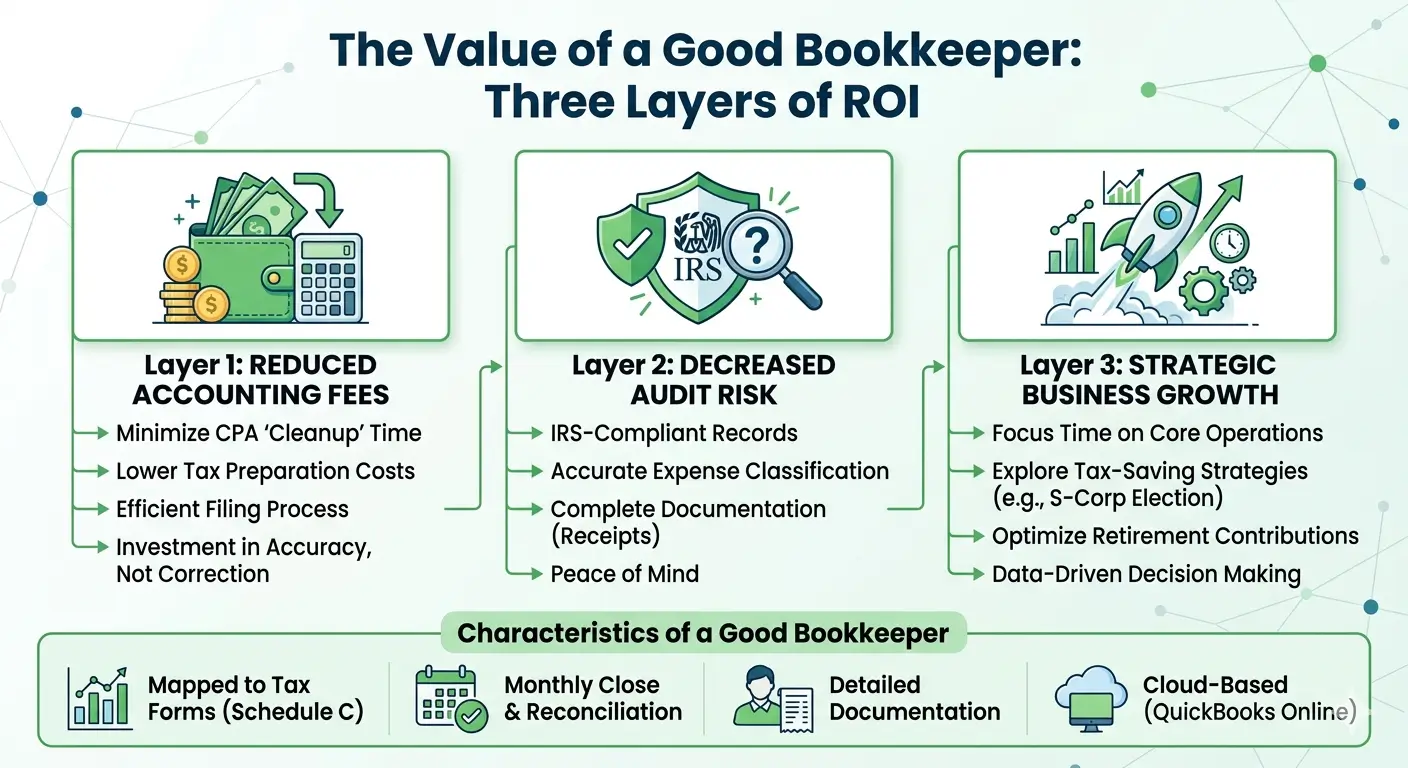
Table of Contents
- 1. Meet Joseph and Helen
- 2. What Their Books Actually Looked Like
- 3. Why an EA Loves Books Like This
- 4. The Real Cost Difference — In Numbers
- 5. What Makes a Good Bookkeeper Different — Four Traits
- 6. How to Tell If Your Bookkeeper Is the Right One
- 7. EA Insight
- 8. Frequently Asked Questions
- 9. Related Articles
- 10. Official Resources
1. Meet Joseph and Helen
Joseph and Helen Kim have run the same antique store for 25 years. They came from Korea with an eye for furniture and ceramics, and they built that into a shop that handles East Asian antiques and vintage furniture side by side.
They came to me as a new client this season. Annual revenue around $1.1M, structured as a single-member LLC (disregarded entity), filing on Schedule C.
At our first meeting, Joseph said something that, after 20+ years in this work, I’ve learned to take with cautious hope:
I always brace myself before opening a new client’s books. The first season is almost always cleanup. Reclassifying categories, hunting down missing transactions, separating personal from business, checking for skipped 1099 filings — that’s days of work before the actual return preparation can even start.
I logged into Joseph’s QBO and spent about thirty minutes scrolling through it. Then I sent a short email.
2. What Their Books Actually Looked Like
Here’s what twelve months of Joseph’s books looked like.
| Item | State of the Books |
|---|---|
| Chart of Accounts | Mapped 1:1 to Schedule C lines (Line 8 advertising, Line 17 legal & professional, Line 22 supplies, Line 24a travel — separated correctly) |
| Transaction Classification | Closed monthly. Uncategorized transactions: 0. |
| Personal vs. Business | Fully separated. No mixed cards, no commingled charges. |
| 1099-NEC Tracking | W-9 on file for every vendor; vendors over the $600 threshold flagged automatically. |
| Inventory (COGS) | Antique-specific lot costing — each piece tracked, matched at point of sale. |
| Fixed Assets & Depreciation | Items above $2,500 separately classified; depreciation schedule maintained off-system. |
| Bank & Card Reconciliation | Reconciled monthly; all 12 months balanced. |
| Owner’s Draw | Cleanly separated into a dedicated equity account. |
The most striking thing about these books wasn’t what was there — it was what wasn’t. Put another way: there was no noise in the books. Not a single transaction made me pause to ask, “Where does this go?” Every category name matched a tax return line. Meal entries had notes attached: who, what meeting, what business purpose. Receipts were linked next to the transactions themselves.
On books like these, an EA’s job is small. And that’s the point.
3. Why an EA Loves Books Like This
Receiving clean books from a good bookkeeper means more to an EA than just convenience. The quality of the return itself changes.
(1) Time shifts from cleanup to strategy.
With messy books, 80% of the season is spent on reclassification. With clean books, that 80% moves to tax-saving strategy. In Joseph’s case, I finished the return early and used the remaining time to model two scenarios for next year. (Side note unrelated to this story — at $1M revenue, Schedule C carries a heavy SE tax burden. An S-Corp election is worth a serious look at this scale.)
(2) Return accuracy goes up.
When the bookkeeper’s classifications already match return lines, fewer mistakes happen in the transfer. Antique stores are particularly tricky — COGS, consignment treatment, appraisal fees, storage and freight — and because the bookkeeper had handled all of it monthly, it flowed straight into the return.
(3) Audit risk drops.
Every return runs through the IRS DIF score system (Discriminant Inventory Function). A $1M Schedule C is unquestionably a return the algorithm watches. But when expense ratios sit inside industry norms, classifications are clean, and documentation is in place, the return tends to drift down the audit priority list.
(4) The preparer signs the return with confidence.
Every return ends with “Under penalties of perjury…” — and the preparer signs alongside the taxpayer (IRC §6694, §6695). When the books underneath the return are clean, that signature feels different. I sign without hesitation.
4. The Real Cost Difference — In Numbers
This is the question business owners actually want answered. “How much money does this really save?” Here it is, in numbers.
| Scenario | Time Required | Estimated Tax Prep Fee |
|---|---|---|
| Joseph’s actual case (clean books) |
≈ 6 hours of return work | ≈ $1,500 |
| If the books were a mess (hypothetical) |
15+ hours cleanup + 6 hours return ≈ 21 hours | ≈ $5,000–$6,500 |
| Difference | — | ≈ $3,500–$5,000 saved |
Now factor in the bookkeeper’s monthly fee.
| Item | Annual Amount |
|---|---|
| Outside bookkeeper (≈ $400/month) | $4,800 |
| Tax prep savings | −$3,500 to −$5,000 |
| Net out-of-pocket | ≈ break-even, or close to it |
And here’s where the math gets interesting. Joseph and Helen are at break-even before any of the invisible savings start counting. Everything below is on top of that:
- The owner’s own time — 30 to 40 hours a year that would otherwise be spent on receipts and QBO entry, now back in the business.
- Reduced audit exposure — even one IRS examination can mean thousands in representation fees.
- Avoided penalties — misclassified expenses that would have generated additional tax and penalties simply never enter the books.
- Tax-saving strategy time — when the EA isn’t cleaning up, real planning happens.
Bottom line
An outside bookkeeper isn’t a cost. It’s an investment with measurable ROI.
5. What Makes a Good Bookkeeper Different — Four Traits
Break Joseph’s bookkeeper’s work down piece by piece, and the gap between average and good becomes clear.
(1) Categories mapped to tax return lines.
An average bookkeeper uses QuickBooks default categories like “Office Supplies.” A good bookkeeper maps that into Schedule C Line 22 (Supplies). Same transaction. Different result.
(2) Documentation built to IRS standards.
Meals, travel, and vehicle expenses have to satisfy IRC §274(d), which requires contemporaneous records — created at the time of the transaction. Joseph’s bookkeeper required a “who and why” note at entry. That alone makes the books audit-ready.
(3) Monthly close — not a year-end scramble.
No 12-month dump in January. Reconciliations were closed every month, uncategorized items zeroed out. By the time April arrived, there were no surprise transactions for the EA to investigate.
(4) Cloud-based work (QuickBooks Online).
No file exchanges. Bookkeeper, owner, and EA all viewed the same QBO. There was no “send me the file” delay in April. One login, everything visible, real-time.
Get those four right, and any small business can become the one whose preparer says, “there’s nothing left for me to fix.”
6. How to Tell If Your Bookkeeper Is the Right One
Whether you already have a bookkeeper or you’re about to hire one, walk through this list.
- Is your chart of accounts mapped to your business’s tax return lines (Schedule C, 1120-S, etc.)?
- Are your books closed and reconciled monthly — not stuffed into a year-end pile?
- Is the line between personal and business clearly drawn — not just dumped into the books and dealt with later?
- For vendors paid over $600, is a W-9 collected automatically, with 1099-NEC tracking in place?
- Do meal, travel, and vehicle entries include date, purpose, and attendees as required by IRC §274(d)?
- Is the work done in a cloud-based system (QuickBooks Online) — or are desktop files being passed back and forth?
- Can your tax preparer log in directly? Is there no “data conversion” step in April?
- Do you get a few “how should I categorize this?” questions every month? A bookkeeper who never asks isn’t being efficient — they’re guessing. A good bookkeeper checks in regularly.
- Has your tax preparer ever told you, “these books are clean”?
That last one is the giveaway. The bookkeeper your tax preparer praises is the bookkeeper who’s actually working for you.
EA Insight
The first thirty minutes I spend looking at a new client’s books usually tells me how the rest of the season will go. What I see in those minutes decides whether I’ll spend the next several weeks cleaning up — or actually planning.
Books like Joseph’s are honestly the exception. Most new clients don’t show up with messy books because of bad intent. They show up that way because nobody ever set them up with a bookkeeper who knew what good looks like.
And that gap shows up in the owner’s tax prep bill. Hours spent on cleanup translate directly into fees. The bigger problem is what gets crowded out. Strategy work. The S-Corp election conversation. Retirement contribution timing. Estimated tax adjustment for the year ahead. The owner pays for cleanup, then never gets the planning that should have been part of the package.
After watching this pattern year after year, I came to one conclusion. Even the best EA can only deliver half their value when the books arriving in April are a mess. So I started recommending good bookkeepers to my clients. And for the clients who didn’t have one, I started providing that level of bookkeeping myself — the kind of books I’d want to receive in April. Built the same way I’d want to read them.
EA Summary
A good bookkeeper isn’t an expense — it’s an investment. Clean books mean the tax preparer doesn’t burn hours on cleanup, which directly lowers the tax prep bill, raises return accuracy, reduces audit risk, and — most importantly — frees the preparer to actually do tax planning. Joseph’s antique store, at $1.1M in revenue, is a living example of what one good bookkeeper can do for a business. The person classifying transactions every month is, more often than not, the person making the biggest financial difference in the year.
Frequently Asked Questions
Is paying a bookkeeper $400–$500 a month really worth it?
It’s basic math. Add the tax prep savings, the owner’s own reclaimed time (valued at any reasonable hourly rate), and the reduced audit exposure — the total almost always exceeds the bookkeeping fee. For any business above $500K in revenue, the question isn’t “should I have a bookkeeper?” It’s “which bookkeeper should I have?”
If I use QuickBooks Online myself, do I still need a bookkeeper?
Tools don’t produce results — people using tools do. QBO is a knife. The cut depends entirely on who’s holding it. A business owner running daily operations isn’t going to think through IRC §274(d) substantiation rules in real time. That’s the bookkeeper’s job.
Wouldn’t it be simpler if my CPA or EA handled the bookkeeping too?
Sometimes. Bundling can be convenient, but it’s typically more expensive. Splitting the roles — a strong bookkeeper plus a strong tax preparer working in coordination — is often more cost-efficient and creates cleaner accountability. The key is whether both professionals are working to the same standard.
Do small self-employed businesses really need a bookkeeper?
It’s about complexity, not size. A rideshare driver bringing in $50K with daily transactions probably needs one. A consultant earning $200K with simple invoicing might handle it themselves. The deciding factors are transaction volume + category complexity + how much time the owner can realistically commit.
How big is the price gap between an average and a good bookkeeper?
Surprisingly small. Average bookkeepers run roughly $300–$400 a month; good ones, $400–$500. About $100 a month buys all four advantages we covered (lower tax prep cost, recovered time, reduced audit risk, real strategy time). The goal isn’t an expensive bookkeeper. It’s the right bookkeeper.
Official Resources
Disclaimer: This article is for educational and informational purposes only and does not constitute tax, legal, or financial advice. Tax laws and regulations change frequently. Always consult a qualified tax professional for advice specific to your individual situation. eataxwise.com and its author are not responsible for any actions taken based on the information provided in this article.