
How Self-Employed Taxpayers Should Track Business Expenses
Most self-employed taxpayers don’t think about expense tracking until January — and by then, the records are gone, the categories are a mess, and legitimate deductions get left on the table. A bookkeeping system built around Schedule C from day one changes what you can prove at tax time.
Key Takeaways
- Schedule C reports self-employment income and deductions; each expense maps to a specific line the IRS reads directly.
- IRC §274(d) requires contemporaneous documentation of business purpose, date, and amount — a receipt alone isn’t enough.
- A chart of accounts built around Schedule C categories turns year-end filing into a data transfer, not a reconstruction project.
- Mixing personal and business expenses in one account is the single most common — and most expensive — mistake self-employed taxpayers make.
- You don’t need a bookkeeper to get started. You need the right categories, applied consistently, from the first transaction.
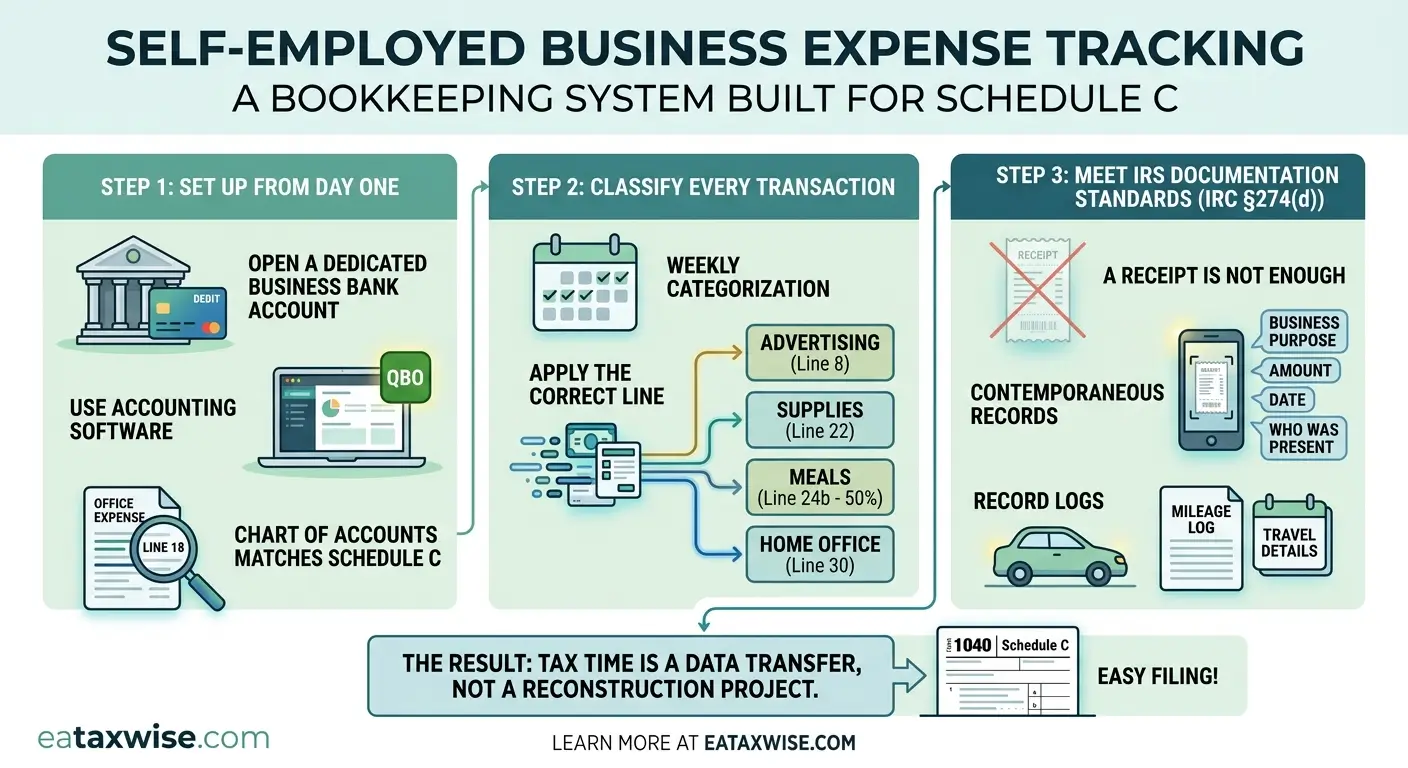
Table of Contents
- 1. Why Expense Tracking Fails for the Self-Employed
- 2. What Schedule C Actually Requires
- 3. The IRS Documentation Standard: IRC §274(d)
- 4. How to Set Up Your Books
- 5. From My Own Books: How I Track eataxwise.com
- 6. The Most Common Mistakes
- 7. EA Insight
- 8. Frequently Asked Questions
- 9. Related Articles
- 10. Official Resources
1. Why Expense Tracking Fails for the Self-Employed
Tax time arrives. You open the bank app. Twelve months of transactions stare back at you — some clearly business, some clearly personal, and a long gray middle where you genuinely can’t remember what that charge was for.
This is the pattern I see every filing season. Self-employed clients arrive with good intentions and incomplete records. They worked hard, they earned real money, and they spent real money on their business. They just never built a system to record what they spent, why they spent it, and which deductions it creates.
Self-employment comes with legitimate deductions: software, professional development, advertising, home office, mileage. These reduce your taxable income dollar for dollar. The obstacle isn’t finding the deductions. It’s proving them when the IRS asks.
2. What Schedule C Actually Requires
Schedule C is the tax form self-employed taxpayers use to report business income and deductions. Part I covers revenue. Part II — where most of the action is — organizes expenses across roughly 20 separate lines, each representing a distinct category.
The IRS reads every line independently. A bookkeeping system that mirrors this structure means your records and your tax return are already speaking the same language. When the IRS questions a specific line, you need to show every transaction flowing into it — date, amount, vendor, and business purpose. A single lump called “miscellaneous” won’t hold up.
The most commonly used Schedule C expense lines for self-employed individuals and small businesses:
| Line | Expense Category | Common Examples |
|---|---|---|
| 8 | Advertising | Paid ads, sponsored content, promotional materials |
| 9 | Car and truck expenses | Business mileage, vehicle operating costs |
| 11 | Contract labor | Freelancers and independent contractors you paid |
| 17 | Legal and professional services | Accounting fees, legal fees, professional services |
| 18 | Office expense | Software subscriptions, website hosting, domain fees |
| 22 | Supplies | Office materials, small equipment, consumables |
| 23 | Taxes and licenses | Business licenses, professional registration fees |
| 24b | Meals (business) | Business meals with clients or colleagues (50% deductible) |
| 25 | Utilities | Business phone, internet (business portion) |
| 27a | Other expenses | Professional development, continuing education, subscriptions not covered above |
Note: Line 27a (“Other expenses”) requires an itemized supporting schedule — you can’t simply enter a total. Each expense category must be listed separately with its corresponding amount.
3. The IRS Documentation Standard: IRC §274(d)
IRC §274(d) sets the documentation rules for several common self-employment expense categories: meals, travel, and listed property (which includes vehicles and certain electronics). For these expenses, a receipt alone isn’t enough. The IRS requires a contemporaneous record showing:
- Business purpose — what business objective the expense served
- Amount — the actual cost
- Date — when the expense occurred
- Place — where it happened
- Who was present — for business meals, the names and business relationship of attendees
A brief note added to your bookkeeping software at the time of the transaction satisfies this standard. What doesn’t satisfy it: trying to reconstruct the business purpose from memory six months later, or submitting a bank statement with no additional documentation.
The critical word in §274(d) is contemporaneous. The record has to exist at or near the time of the expense. If the IRS audits and you can’t produce it, the deduction gets disallowed — regardless of whether the expense was completely legitimate.
Practical standard for general business expenses: Even for expenses not covered by §274(d), IRS Publication 583 recommends keeping records that show the amount, date, place, and business purpose. The documentation habit you build for §274(d) items protects your entire Schedule C — not just the listed categories.
4. How to Set Up Your Books
The goal is straightforward: every business transaction gets categorized the moment it comes in, mapped to the right Schedule C line. Not saved for later. Not sorted at year-end. Once, when the transaction happens.
QuickBooks Online is built around this workflow. Connect your business bank account and credit card, and QBO pulls transactions in automatically. Your job is to assign each one to the right account in your chart of accounts. That chart of accounts is the foundation — and it should mirror Schedule C Part II from the start.
Three things to do when setting up QBO for a Schedule C business:
- Open a dedicated business bank account. One account for business, nothing else. This is the cleanest boundary you can draw between personal and business finances — and it makes bookkeeping dramatically simpler.
- Build your chart of accounts around Schedule C lines. Name accounts to match the categories you actually use. Advertising, Office Expense, Professional Development, Legal & Professional. Turn off accounts for categories that don’t apply to your business.
- Categorize weekly, not annually. A weekly 15-minute review catches errors while the transactions are still fresh. Doing it once a year means doing it badly.
5. From My Own Books: How I Track eataxwise.com
I run eataxwise.com as a Schedule C business. Every expense the site generates flows through QuickBooks Online, categorized the same day it hits my business account. The business purpose for each transaction is documented in QBO’s memo field at the time of entry — not reconstructed later.
Here’s how the chart of accounts maps to Schedule C for a content-based tax education business:
| Expense Category | Schedule C Line | What Goes Here |
|---|---|---|
| Advertising | Line 8 | Paid promotion, sponsored content, future ad spend |
| Website & Hosting | Line 18 | Domain registration, web hosting, SSL certificate |
| Software & Subscriptions | Line 18 | AI writing tools, video production software, WordPress plugins, site management tools |
| Legal & Professional | Line 17 | Tax software, professional service fees |
| Office Supplies | Line 22 | Hardware peripherals, office materials, small equipment |
| Taxes & Licenses | Line 23 | Professional licensing fees, EA renewal |
| Professional Development | Line 27a | Continuing education, EA study materials, reference resources |
At tax time, I run a Profit & Loss report by account in QBO. The numbers transfer directly onto Schedule C. No reconstruction, no guessing, no archaeology through 12 months of bank statements.
That’s the point of building your books around Schedule C from the start: filing becomes a data transfer. The work happens throughout the year, in small increments, while the transactions are still fresh.
Is Your Chart of Accounts Built for Schedule C?
If your QBO categories don’t map directly to Schedule C lines, you’re making tax time harder than it needs to be — and you may be leaving deductions on the table. The free Bookkeeping Review takes a look at how your books are structured and flags what needs to change.
Request a Free Bookkeeping Review →6. The Most Common Mistakes
Using one bank account for everything
Personal and business transactions in the same account means every reconciliation requires judgment calls. Is that Amazon charge business or personal? When you can’t remember, the deduction disappears. A dedicated business account eliminates the question entirely.
Saving categorization for year-end
December categorization of January transactions is guesswork. You won’t remember the business purpose of a charge from eleven months ago. The IRS requires contemporaneous documentation — “I think this was for work” written in January doesn’t qualify.
Using the wrong Schedule C line
Dropping everything into Line 27a (“Other expenses”) because it’s easier is a red flag. The IRS expects to see expense amounts spread across the appropriate lines. An unusually large Line 27a relative to other lines can draw attention to a return.
Skipping the home office calculation
If you use part of your home regularly and exclusively for business, you may qualify for the home office deduction. Many self-employed taxpayers skip it because the calculation seems complicated. It isn’t — especially with the simplified method, which allows a standard rate per square foot of dedicated business space. That said, the actual expense method — which calculates the real cost of utilities, rent or mortgage interest, and depreciation based on your business-use percentage — often produces a larger deduction. The simplified method is easier; the actual expense method may be worth the extra work depending on your situation.
Not tracking mileage at the time of travel
The IRS requires a mileage log that shows date, destination, business purpose, and miles driven for each trip. Reconstructing it from memory at year-end doesn’t satisfy §274(d). Apps that log trips automatically, or a simple note in your calendar right after each drive, both work.
EA Insight
The clients who come in the least prepared aren’t the ones who made mistakes. They’re the ones who built no system at all. No categories, no documentation, nothing contemporaneous. They ran a real business, earned real income, incurred real expenses — and arrived at my desk with a year of bank statements and no way to connect the transactions to a business purpose.
The IRS position on this is consistent: if you can’t document the business purpose of an expense at the time it was incurred, you can’t deduct it. Good intentions don’t count after the fact. “I’m pretty sure that was for work” isn’t documentation. Neither is a bank statement alone.
When I launched eataxwise.com, I connected QuickBooks Online before the first transaction hit. Setting up the chart of accounts took about an hour. Every expense since then has been categorized the same week it appears — business purpose noted in the memo field, mapped to the right Schedule C line. When I prepare my own return, the Profit & Loss report does most of the work. That hour upfront has paid for itself dozens of times over.
The earlier you build the system, the less work it takes to maintain. Waiting until you’re profitable, or until you hire someone, or until “things settle down” means starting with a backlog. Start with the first transaction.
Frequently Asked Questions
Do I need accounting software if I’m just starting out?
Not necessarily — but you need a system. A spreadsheet with columns for date, vendor, amount, business purpose, and Schedule C line can work at the beginning. The problem with spreadsheets is that they require manual entry and offer no bank connection, which makes them easy to neglect. Accounting software that pulls transactions automatically removes the friction that causes most systems to break down.
Can I use my personal bank account for my business?
The IRS doesn’t require a separate business account, but using one is strongly advisable. When business and personal transactions share an account, every reconciliation requires sorting — and anything you can’t clearly identify as business gets left out of your deductions. A dedicated business account costs almost nothing to open and removes a significant source of error and missing documentation.
What if I already have months of uncategorized transactions?
Start where you are. Go back through your statements and categorize what you can document — if you can identify the business purpose of the expense and you have a receipt or record, include it. Anything you can’t clearly document should not be claimed. Then build a prospective system so the backlog doesn’t grow. A qualified tax professional can help you determine what’s recoverable from the prior period.
How do I handle expenses that are partly personal and partly business?
You can deduct the business portion only. For something like a phone used for both personal and business calls, you’d estimate the business-use percentage based on actual usage and deduct that share. Keep a record of how you calculated the percentage. The home office deduction works similarly — the deductible amount is based on the square footage of the dedicated business space as a percentage of total home square footage.
Does the IRS require digital records, or will paper receipts work?
Both are acceptable. IRS Rev. Proc. 98-25 confirms that electronic records meet the same standards as paper. Many taxpayers photograph receipts immediately and store them digitally — this works well because paper receipts fade. Whatever format you choose, the underlying documentation requirements are the same: date, amount, vendor, and business purpose.
Official Resources
Disclaimer: This article is for educational and informational purposes only and does not constitute tax, legal, or financial advice. Tax laws and regulations change frequently. Always consult a qualified tax professional for advice specific to your individual situation. eataxwise.com and its author are not responsible for any actions taken based on the information provided in this article.