
Why Your Bookkeeper Should Be an Enrolled Agent
Most small business owners think of bookkeeping as tidying up numbers. But every transaction you record ends up in one place — your tax return. The question is whether your books were built the way the IRS reads them, or just the way your bookkeeper found convenient.
Key Takeaways
- Bookkeeping has one final destination: your tax return. If the books aren’t structured around that, someone has to rebuild them at filing time — and you usually pay for that twice.
- An Enrolled Agent (EA) is a tax professional federally authorized by the IRS. When an EA keeps your books, Schedule C line mapping, documentation standards, and audit readiness are built in from the first entry.
- A general bookkeeper categorizes transactions. An EA organizes them into a form that can actually be filed. Those look similar — they aren’t the same thing.
- An EA can represent you before the IRS directly through Form 2848. The person who built your books can speak to the IRS about them.
- EA bookkeeping doesn’t replace your CPA. It hands your CPA a set of books they don’t have to touch again.
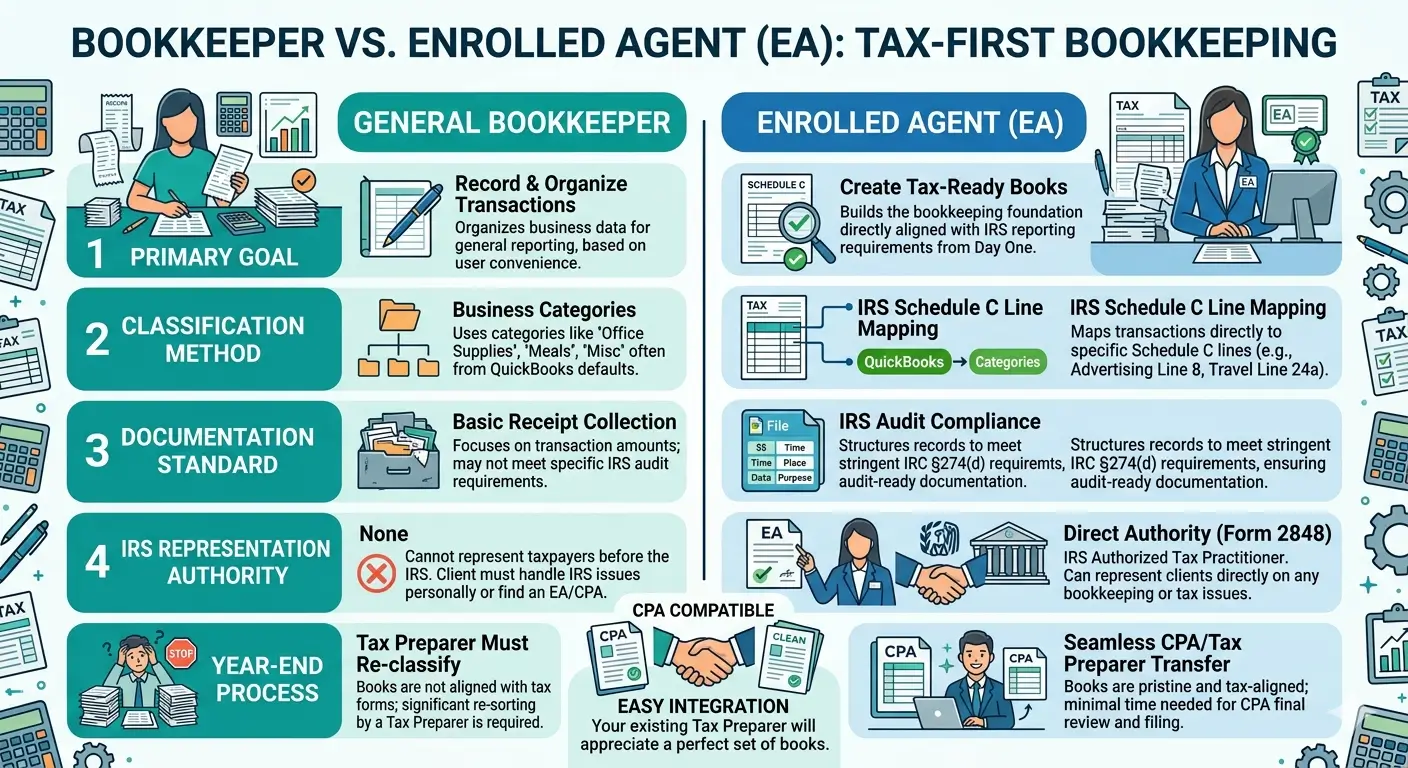
Table of Contents
1. Where Bookkeeping Actually Ends
Think of bookkeeping as a monthly task and it looks like something that finishes twelve times a year. It really finishes once. When the tax return gets filed.
Every transaction you sorted all year flows into one place. A sole proprietor lands on Schedule C. A corporation lands on Form 1120 or 1120-S. Every line in your books has to map to some line on that return.
Here’s where it breaks down. A lot of bookkeepers sort transactions into whatever category is easiest — the defaults QuickBooks hands them, or whatever buckets they’re used to. When those buckets don’t line up with the actual tax return, your tax preparer has to receive the books and remap them from scratch. The same work, done twice. And the bill for that second pass usually lands on the owner.
2. What an Enrolled Agent Is
An Enrolled Agent is a tax credential issued directly by the IRS. Only three types of professionals can represent taxpayers before the IRS anywhere in the country — attorneys, CPAs, and Enrolled Agents. The EA is the one focused entirely on tax.
Earning the credential means passing a three-part exam written by the IRS, covering individual tax, business tax, and representation procedures — or qualifying through past IRS employment. Keeping it means annual continuing education and staying under Circular 230, the IRS’s own ethics regulation. That last part matters more than it sounds. An EA isn’t just good at the work. An EA is bound by federal law to a strict standard of professional conduct — something a general bookkeeper simply isn’t.
So the difference is this. An EA isn’t a person who tidies up books. An EA is a person who knows how those books will look once they’re standing in front of the IRS.
3. Tax-First Bookkeeping
A general bookkeeper sees a transaction and drops it into a reasonable-looking category. Office Supplies. Meals. Miscellaneous.
Your tax preparer, on receiving those books, opens “Miscellaneous” and checks what’s hiding inside, one item at a time. Then re-sorts everything to the right Schedule C line.
EA bookkeeping maps to the Schedule C line from the very first sort. Line 8 Advertising. Line 9 Car and truck expenses. Line 24a Travel. The moment a transaction comes in, where it lands on the return is already decided.
4. IRS-Standard Documentation
Putting an expense in the books is one thing. Proving that expense in front of the IRS is another.
IRC §274(d) sets a strict documentation bar for certain expenses — travel, vehicle, and similar categories. Amount, time, place, business purpose. Miss any of those four and the expense can be denied in an audit, even though it’s sitting right there in your books.
A general bookkeeper records the amount. EA bookkeeping builds the books so the items §274(d) demands are captured from the start. If an audit comes, you’re not scrambling. It’s already there.
5. Direct IRS Authority
Say something in the books draws a question. The IRS sends a letter asking you to explain a particular item.
A general bookkeeper stops here. They have no authority to speak with the IRS. You handle it yourself, or you go find a tax professional separately.
An EA can act for you before the IRS directly through Form 2848, the Power of Attorney. The person who built your books can talk to the IRS about those books. Whoever understands the context best stays the point of contact — instead of handing it off to someone starting cold.
6. CPA-Compatible
One thing worth saying plainly. EA bookkeeping doesn’t replace your CPA or your existing tax preparer.
If you already have a CPA filing your return, that relationship stays exactly where it is. What EA bookkeeping does is make sure that when your CPA receives the books at filing time, there’s nothing to reorganize.
A CPA welcomes clean books too. The filing goes faster, the back-and-forth questions shrink, the chance of an error drops. EA bookkeeping isn’t competing with your CPA. It’s making your CPA’s job easier.
7. General Bookkeeper vs. EA Bookkeeper
| Category | General Bookkeeper | EA Bookkeeper |
|---|---|---|
| How transactions are sorted | Convenient categories | Mapped to Schedule C lines |
| Documentation | Amount only | Meets IRC §274(d) standard |
| Authority before the IRS | None | Direct representation via Form 2848 |
| When handed to a tax preparer | Needs rebuilding | Ready to use as-is |
| Professional regulation | None | Bound by Circular 230 |
EA Insight
Last year I took over the books for a couple who run a dry cleaner. Something stood out on the first page. Grocery runs at the local Korean market, the kids’ taekwondo tuition, summer camp fees — all of it booked as business expense. That’s how the previous accountant had sorted it.
From the owner’s side it probably looked great. More expenses, less tax. But those books weren’t built the way the IRS reads them. When a dry cleaner reports an expense ratio that drifts far from the industry norm, that gap is an audit trigger on its own. And if an audit surfaces personal spending dressed up as business cost, it doesn’t end with paying the tax back. A 20% accuracy-related penalty follows — and depending on what’s found, the consequences get heavier from there.
I pulled every one of those items out. The tax bill went up. The owner told me, “but our old accountant did all of this for us.” He did. He did all of it — right up until there was a problem.
Books aren’t built to shrink the tax bill. They’re built to make the tax accurate, and defensible in front of the IRS. That’s the difference — and it’s why the person knowing that difference should be the one keeping your books. The full story of this case is covered in our Tax Stories.
Not sure your books are being kept the way the IRS reads them?
Before there’s ever a notice or an audit, the books can be checked. A bookkeeping review tells you where you stand — and what, if anything, needs to be cleaned up.
Request a Bookkeeping ReviewFrequently Asked Questions
I already have a bookkeeper. Do I need to switch?
Not necessarily. But if your tax preparer reorganizes your books every year, it’s worth asking where that cost is coming from — and whether it’s showing up on your bill.
My CPA handles my tax filing. Does EA bookkeeping conflict with that?
No. EA bookkeeping prepares the books your CPA will receive. It supports the filing relationship you already have rather than competing with it.
I’m already using QuickBooks. Does that work?
Yes. This bookkeeping service is built for QuickBooks Online users. Your existing data carries over and the work continues from there.
Can I have my books kept here but file my taxes elsewhere?
Yes. The scope of this service is bookkeeping. You can keep filing your tax return with your existing preparer.
What does it actually mean for a bookkeeper to be an Enrolled Agent?
It means the person keeping your books is federally authorized by the IRS, can represent you before the IRS, and is bound by federal ethics rules under Circular 230. The books are kept by someone who knows how they’ll be read at the other end.
Official Resources
Disclaimer: This article is for educational and informational purposes only and does not constitute tax, legal, or financial advice. Tax laws and regulations change frequently. Always consult a qualified tax professional for advice specific to your individual situation. eataxwise.com and its author are not responsible for any actions taken based on the information provided in this article.